Wind Energy Technology
Yaw Drive Planetary Gearbox for Wind Turbines
A comprehensive technical guide covering working principles, engineering standards, material composition, and real-world applications — with a focus on requirements for wind energy projects in Colombia and across Latin America.
1. What Is a Yaw Drive Planetary Gearbox?
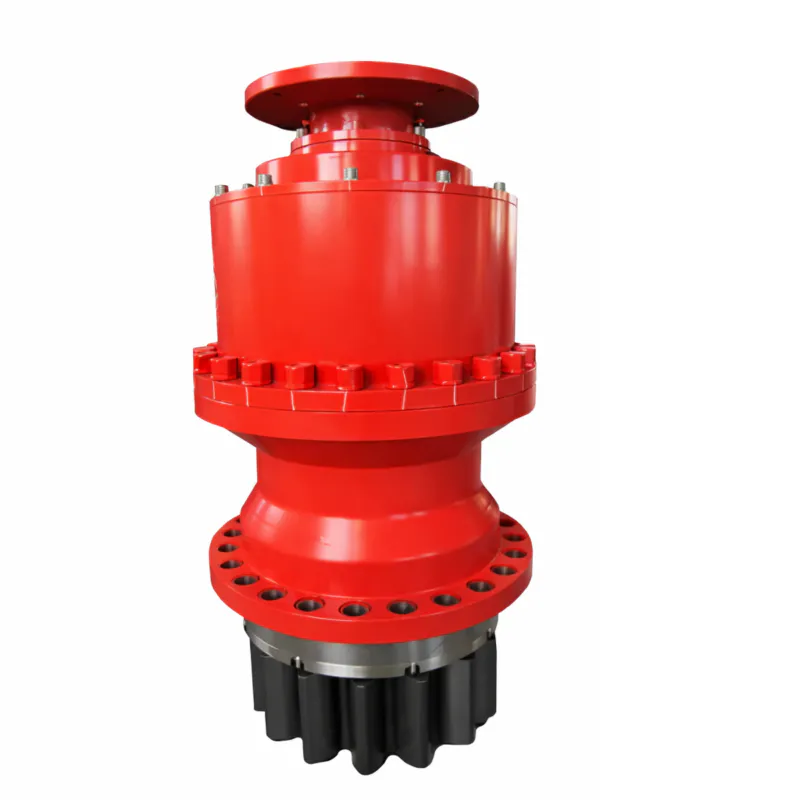
A yaw drive planetary gearbox is the mechanical heart of a wind turbine’s nacelle orientation system. Its job is deceptively simple to describe — rotate the nacelle so that the rotor blades always face into the wind — yet the engineering behind it is anything but simple. The nacelle on a commercial-scale turbine weighs anywhere from 50 tonnes to well over 400 tonnes depending on rated capacity, and rotating it smoothly, precisely, and reliably under constantly shifting wind loads demands a drive system capable of generating enormous output torque from a compact, long-service package.
Planetary gear arrangements are the preferred solution because they distribute load across multiple meshing points simultaneously. Rather than channelling all torque through a single gear pair, a planetary stage splits the force among three or more planet gears that orbit a central sun gear and engage an outer ring gear. The load-sharing geometry translates into dramatically higher torque density per unit volume compared with conventional parallel-shaft designs — which is exactly why engineers specify planetary drive gearboxes whenever space, weight, and output torque requirements converge in demanding environments like wind turbine nacelles.
The EP series yaw drive planetary gearbox builds on these fundamentals and adds refinements suited to the demanding duty cycles, wide temperature swings, and remote locations characteristic of modern wind farms — including the high-altitude sites found in the Colombian Andes and the Caribbean coast, where UV radiation, humidity, and temperature variation create additional mechanical stress on drivetrain components.
2. How the Yaw Drive System Works
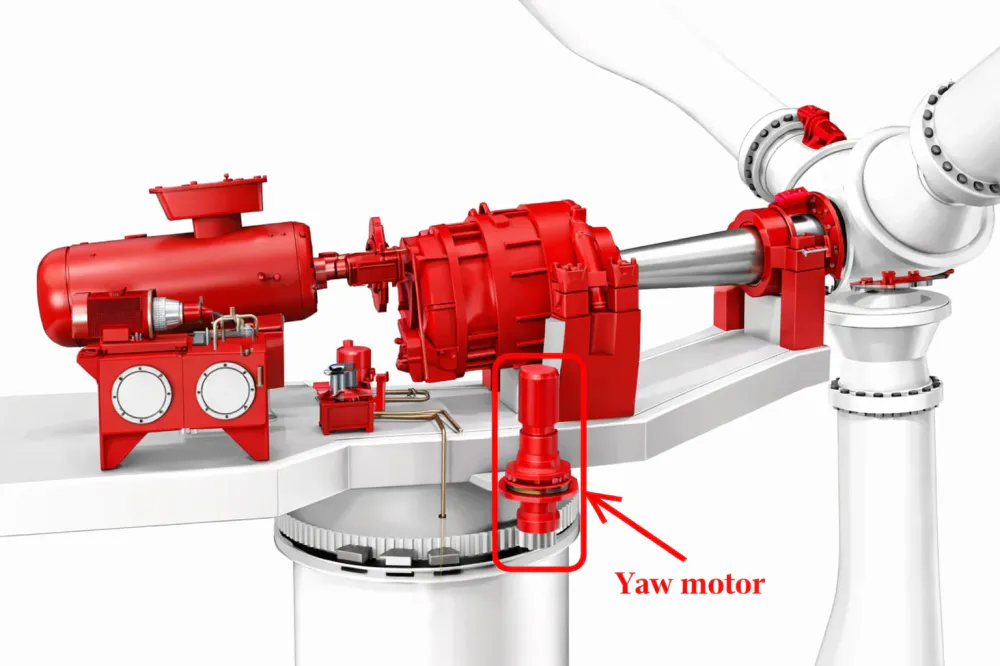
The yaw control process begins at the wind vane — a sensor mounted on top of the nacelle that continuously measures wind direction and feeds that data to the turbine’s programmable logic controller (PLC). When the measured wind angle deviates beyond a preset threshold (typically ±8° to ±15°), the controller activates the yaw drive motors. Each motor transmits rotational energy into the yaw drive planetary gearbox, which steps the high-speed, low-torque motor output down to the slow, high-torque rotation needed to pivot the nacelle smoothly on its yaw ring. Most systems require reduction ratios between 1:1,200 and 1:2,000 to produce the turning moments involved.
Inside a multi-stage planetary yaw gearbox — three or four reduction stages are typical — each stage consists of a sun gear, a set of planet gears (usually three per stage), a planet carrier, and a fixed ring gear. The motor shaft drives the first-stage sun gear. The planet gears orbit the sun, and because the ring gear is fixed to the housing, the planet carrier is forced to rotate. That carrier output becomes the input for the next stage, and so on. Each stage multiplies torque while reducing speed. By the final stage, the pinion output shaft engages the large-diameter yaw ring gear bolted to the tower top, causing the entire nacelle to pivot.
Hydraulic or electromechanical yaw brakes work in concert with the gearbox. When the nacelle reaches the correct heading, the brakes apply clamping force to the yaw ring and hold the nacelle steady against wind-induced moments — a critical design consideration for turbines operating in the gusty, turbulent wind regimes common along the Colombian coast and in Andean passes. The planetary gearbox for wind turbine yaw systems must therefore cope with holding loads as well as dynamic rotation loads, demanding exceptional robustness in bearings, housings, and gear flanks alike.
① Wind Detection
The vane sensor feeds real-time wind direction data to the PLC, which computes yaw error and decides whether to activate the drive.
② Multi-Stage Reduction
Three or four planetary stages multiply motor torque to the levels needed to pivot a nacelle weighing tens of tonnes — smoothly and without shock loads.
③ Pinion–Ring Engagement
The output pinion meshes with the fixed yaw ring on the tower top, converting gearbox rotation into controlled nacelle movement.
3. Technical Specifications — EP Yaw Drive Planetary Gearbox
The table below lists representative technical parameters for the EP series yaw drive planetary gearbox designed for wind turbine applications. Values are applicable to mid-range horizontal-axis turbines between 1.5 MW and 3 MW, the capacity class most commonly deployed in Colombian wind energy projects such as those in La Guajira and Cesar departments. Project-specific sizing should always be confirmed with the technical data sheet for the selected model.
| Parameter | Specification / Value |
|---|---|
| Product Model | EP-YD Series (Yaw Drive Planetary Gearbox) |
| Applicable Turbine Capacity | 1.5 MW – 5.0 MW (Horizontal Axis) |
| Number of Planetary Stages | 3 – 4 stages |
| Gear Ratio (Input:Output) | 1,200:1 – 2,000:1 |
| Rated Input Speed | 1,450 rpm |
| Output Speed (nacelle rotation) | 0.5 – 1.2 rpm |
| Rated Output Torque | 120,000 N·m |
| Peak / Emergency Output Torque | 180,000 N·m |
| Number of Planet Gears per Stage | 3 |
| Gear Material | 20CrMnTi / 17CrNiMo6 alloy steel |
| Gear Surface Hardness (after heat treatment) | HRC 58 – 62 |
| Gear Core Hardness | HRC 30 – 45 |
| Gear Accuracy Grade | ISO 1328-1, Grade 5 – 6 |
| Housing Material | Nodular cast iron QT500-7 |
| Lubrication Type | Synthetic gear oil – ISO VG 320 |
| Sealing System | Triple-lip seal + labyrinth seal (dust & moisture) |
| Operating Temperature Range | -40°C to +80°C |
| Ingress Protection Rating | IP65 |
| Standard Mounting Position | Vertical – motor mounted at top |
| Design Service Life | ≥ 20 years under rated operating conditions |
* Parameters are indicative for the mid-power EP-YD series. Final values depend on the specific turbine configuration and site requirements.
4. Five Key Product Advantages
Exceptional Torque Density
The multi-planet load-sharing architecture allows the EP yaw drive planetary gearbox to transmit output torques up to 180,000 N·m — exceeding what an equivalent parallel-shaft gearbox would require in the same installation envelope by a significant margin. This makes it possible to reduce nacelle weight and simplify structural design.
Long Service Life in Harsh Climates
Gears are precision-cut from 20CrMnTi alloy steel, carburized, quenched, and tempered to achieve HRC 58–62 surface hardness alongside a tough core. Combined with a triple-lip and labyrinth sealing system and IP65-rated housing, the unit is built to run for 20 years or more — even in the salt-spray, high-humidity conditions of Colombia’s Caribbean coast wind zones.
Precise Nacelle Positioning
The planetary drive gearbox achieves ISO 1328-1 Grade 5–6 gear accuracy, ensuring smooth, backlash-controlled positioning so the nacelle tracks wind direction without hunting or oscillation. Precise yaw alignment directly increases annual energy production (AEP) — a critical factor in the bankability of wind projects financed by Colombian or international energy funds.
Low Maintenance Requirements
Synthetic ISO VG 320 gear oil maintains consistent viscosity across the operating temperature range of -40°C to +80°C. Oil change intervals are extended compared with mineral oils, and the sealed lubrication circuit minimizes contamination ingress — reducing service visits to the nacelle to once per year or less under normal operating conditions, which significantly cuts O&M costs in remote locations.
Compliance-Ready Design
The EP-YD series is engineered in accordance with IEC 61400-4, the internationally recognized design standard for wind turbine gearboxes. This compliance posture simplifies certification processes required under Colombia’s Ley 1715 de 2014 (Renewable Energy Law) and the technical regulations of the Unidad de Planeación Minero Energética (UPME), streamlining project development and grid-connection approval timelines.
5. Material Composition
Material selection is not an afterthought in the design of a yaw drive planetary gearbox — it is the foundation on which everything else rests. The EP-YD series draws on a carefully chosen combination of metallurgical grades, sealing materials, and surface treatments, each selected to maximize durability in the specific thermal, mechanical, and environmental stresses that characterize wind turbine yaw duty.
Gear Blanks
Precision forged from 20CrMnTi or 17CrNiMo6 case-hardening alloy steel. The chromium–molybdenum–nickel chemistry provides a hard, wear-resistant surface layer after carburizing — with depths controlled to 0.8–1.5 mm — while preserving a ductile, impact-resistant core. This gradient structure is what allows gears to survive sustained overloads without sudden fracture.
Housing & Carrier Structures
Main housings and planet carriers are cast from QT500-7 nodular cast iron (also referred to as ductile iron), which offers significantly better impact resistance than grey iron and withstands the thermal cycling inherent in wind turbine operation. Critical load-bearing flanges and bores are finish-machined to tight dimensional tolerances on CNC machining centres.
Bearings
Planet pin and output shaft bearings are full-complement or caged cylindrical and tapered roller types in bearing-quality steel (typically 100Cr6 / SUJ2 grade). Bearing selection follows ISO/TS 16281 life calculation methodology and is checked against the fatigue loads specified in the turbine’s design load document, as required by IEC 61400-4.
Seals & Protective Coatings
Output shaft seals combine fluoroelastomer (FKM) lip seals with a labyrinth groove to create a redundant barrier against both oil egress and environmental ingress. External surfaces receive epoxy primer and polyurethane topcoat for corrosion protection — a combination that endures salt-fog exposure per ISO 9227 for over 1,000 hours without delamination.
6. Regulatory & Standards Framework
Wind turbine components — including the planetary gearbox for wind turbine yaw systems — operate within a multi-layered regulatory environment that spans international standards bodies, regional legislation, and national certification schemes. Understanding these requirements is essential for procurement engineers selecting a wind turbine yaw gearbox supplier in Colombia or evaluating replacement units for existing fleets.
International Standards
IEC 61400-4:2025 (Wind Energy Generation Systems – Part 4: Design Requirements for Wind Turbine Gearboxes) is the primary engineering standard governing wind turbine gearbox design, verification, prototype testing, and serial production testing. It applies to enclosed speed-increasing gearboxes for horizontal-axis turbines with power ratings above 500 kW. For the yaw drive specifically, the standard provides guidance on dynamic load analysis, bearing selection methodology, gear rating, lubrication, and sealing — exactly the areas addressed in the EP-YD series design process.
IEC 61400-1:2019 sets the overarching turbine design requirements and defines the load classes against which all drivetrain components, including yaw gearboxes, must be rated. ISO 1328-1 governs cylindrical gear accuracy grades referenced in the EP-YD’s gear manufacturing specification. ISO 9227 covers salt-spray corrosion testing, relevant for coastal wind farms.
Colombia — Ley 1715 de 2014 and UPME Regulations
Colombia’s Law 1715 of 2014 (“Ley de Energías Renovables”) establishes the framework for non-conventional renewable energy generation, offering tax incentives (income tax deduction, VAT exemption, accelerated depreciation) to wind energy project developers. Projects must pass technical review by the Unidad de Planeación Minero Energética (UPME) and comply with the Reglamento Técnico de Instalaciones Eléctricas (RETIE). For grid-connected wind generators, the interconnection agreement with XM (the grid operator) requires proof that major components — including gearboxes — meet recognized international standards. Specifying an IEC 61400-4-compliant yaw drive planetary gearbox therefore directly supports the certification pathway.
European Union — Machinery Directive 2006/42/EC
Gearboxes supplied to European wind OEMs must meet the EU Machinery Directive, which mandates that mechanical power transmission assemblies carry a Declaration of Conformity and bear CE marking. The EP-YD series is designed to meet the relevant essential health and safety requirements of this directive, which is increasingly referenced by multinational OEMs sourcing components for global projects including those in South America.
United States — AWEA and AGMA Standards
The American Gear Manufacturers Association (AGMA) publishes gear rating standards (notably AGMA 6006 for wind turbine gearboxes) that are widely referenced by US turbine manufacturers. Projects targeting export to the US market, or sourcing turbines from American OEMs for Colombian sites, will encounter AGMA requirements alongside IEC standards. The EP-YD series addresses the key technical parameters covered by both frameworks.
7. Application Scenarios
The EP-YD yaw drive planetary gearbox is designed around the demands of horizontal-axis wind turbine nacelle orientation, but the specific context — onshore, offshore, repowering, or distributed generation — affects which configuration and specification is most appropriate. Below are the principal deployment scenarios where this type of planetary drive gearbox delivers proven value.
Onshore Wind Farms (1.5 MW – 3 MW)
This is the primary market for the EP-YD series. In Colombia, the La Guajira department hosts the country’s most significant wind resource — average wind speeds of 9–11 m/s at 100 m hub height — and multiple projects in the 50–200 MW range are at various stages of development. Each turbine in these parks requires two to six yaw drive units. The EP-YD’s gear ratio range of 1,200:1 to 2,000:1 and output torque up to 180,000 N·m cover virtually all nacelles in this power class, making it a flexible drop-in solution for both new build and replacement procurement across Colombia’s onshore portfolio.
Offshore and Near-Shore Wind Projects
While Colombia’s offshore wind sector is at an earlier stage, global near-shore and offshore markets represent growing demand for yaw gearboxes with enhanced corrosion protection. The EP-YD’s IP65 ingress protection, fluoroelastomer seals, and salt-spray-resistant coatings make it suitable for near-shore deployments in the Caribbean and Pacific coast zones. Offshore nacelles are particularly cost-sensitive to maintenance frequency, so the gearbox’s 20-year design life and long oil-change intervals are especially valuable in this segment.
Wind Farm Repowering and Gearbox Replacement
Repowering — replacing aging first-generation turbines or components with modern, higher-efficiency equipment — is a growing activity globally and increasingly relevant in Latin America as early wind farms approach the end of their original 20-year design lives. A yaw drive planetary gearbox replacement in Colombia typically involves matching the output pinion geometry, flange bolt pattern, and torque rating of the original unit. The EP-YD series covers a broad range of configurations, and the engineering team can assist with dimensional compatibility analysis for specific turbine platforms. Replacement projects benefit from IEC 61400-4’s guidance on re-qualification testing.
High-Altitude and Remote Site Applications
Colombia’s Andean geography introduces site conditions that few other countries face in wind energy development — altitude above 2,000 m AMSL affects air density (and therefore the aerodynamic behaviour of the nacelle under yaw loads), while temperature cycling between warm days and cold nights stresses all drivetrain components. The EP-YD’s wide operating temperature range (-40°C to +80°C) and low-temperature synthetic lubrication oil ensure reliable cold-start performance, while robust housing castings resist thermal fatigue. These characteristics also apply to Andean-altitude wind sites in Peru, Ecuador, and Chile, where similar conditions prevail.
8. About Us
We are a specialist manufacturer of precision planetary gearboxes for demanding industrial and renewable energy applications. Our engineering team draws on decades of accumulated know-how in gear geometry, heat treatment metallurgy, bearing selection, and sealing technology to develop drivetrain solutions that perform reliably across the full design lifetime of the machines they serve.
Our wind energy product line was developed in direct response to the reliability expectations of the global wind industry. Every yaw drive planetary gearbox we produce passes through dimensional inspection, gear contact pattern verification, running-in testing, and functional load testing before leaving the facility. Our quality management system conforms to ISO 9001, and our manufacturing processes are aligned with IEC 61400-4 design and verification requirements.
Workshop

Frequently Asked Questions
Editor: PXY