
Right Angle Planetary Gearbox in Printing Machine Paper Feed and Transport Systems
A technical reference covering motion architecture, structural analysis, material selection, failure modes, and recommended configurations for the printing and paper-handling industry — with focus on the Colombian market and Latin American automation sector.
Paper transport inside a printing press is one of the most mechanically unforgiving environments a motion component can inhabit. Sheets move at speeds exceeding 15,000 impressions per hour, registration tolerances are measured in hundredths of a millimeter, and any angular error in the paper path accumulates instantly into visible misprint. At the heart of this precision challenge sits the right angle planetary gearbox — a compact, high-stiffness transmission architecture that combines the torque density of planetary staging with a 90-degree output orientation critical to the spatial constraints of modern sheet-fed and web offset press frames.
This article is written for mechanical engineers, press maintenance supervisors, and procurement specialists evaluating right angle planetary gearbox solutions for paper feed, sheet transport, and delivery roller systems. Whether you are specifying new equipment for an offset plant in Bogotá, rebuilding the drive train of a wide-format digital press, or sourcing a precision right angle planetary gearbox supplier in Colombia for an automation upgrade project, the technical depth here will guide your decision-making from first principles to final configuration.
The content follows the structure recommended by current mechanical engineering practice and is informed by field experience across high-speed printing environments: sheetfed offset, heat-set web, narrow-web label, and digital inkjet transport systems. Product data referenced draws from competitive specifications in the precision gearbox market; all configurations listed are available as custom-engineered solutions.
1. Motion Architecture: How a Right Angle Planetary Gearbox Works
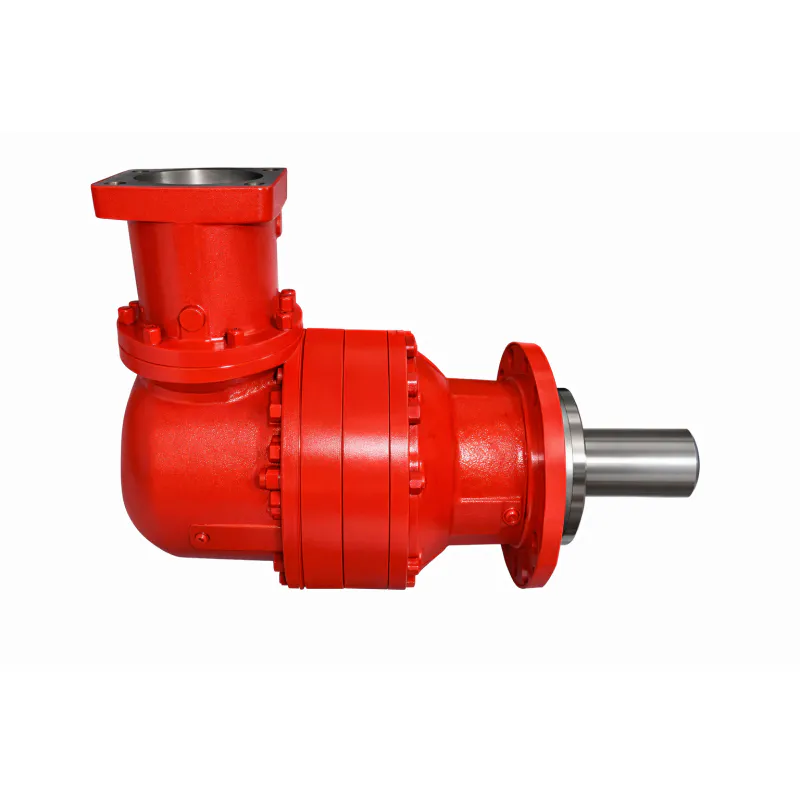
The defining characteristic of a right angle planetary gearbox is the integration of two fundamentally different gear types within a single housing. The first stage — or in multi-stage units, the first several stages — consists of a conventional planetary arrangement: a sun gear driven by the input shaft meshes simultaneously with three or four symmetrically arranged planet gears, which in turn engage an internal ring gear. This arrangement achieves load sharing across multiple mesh points, producing torque density and stiffness far beyond what a parallel-axis helical gear could deliver in the same envelope volume.
What distinguishes the right angle planetary gearbox from its inline counterpart is the bevel gear stage appended at the output end. A spiral bevel pinion — or in premium-grade units, a hypoid bevel set — intercepts the coaxial output of the planetary stages and redirects it through 90 degrees onto an output shaft oriented perpendicular to the input axis. This reorientation is precisely what printing machine frame architecture demands: drive motors are typically mounted in a horizontal plane parallel to the press base, while paper transport rollers spin on shafts running transverse to the paper path. The 90-degree gear drive bridges these two orientations cleanly, without the bending moments, alignment sensitivity, or efficiency losses that would result from external coupling arrangements or worm gear approaches.
In paper feed and sheet transport specifically, the gearbox receives its input from a servo or stepper motor running at 1,000 to 3,000 RPM and delivers reduced output to roller shaft speeds typically in the 30 to 300 RPM range, depending on paper weight, format, and machine speed. The ratio range achievable within a compact two-stage right angle planetary design spans roughly 5:1 to 100:1, covering the full spread of transport speed requirements across different press categories. For the most demanding precision applications — such as register-critical sheet grippers and ink form rollers — low-backlash variants with angular play values below 3 arcminutes are specified, a figure that right angle planetary geometry can reliably achieve through preloaded planet carriers and precision-ground bevel sets.
2. Structural Types Available for Printing Machine Applications
Right angle planetary gearbox configurations divide into three primary structural categories relevant to paper transport applications, each with distinct trade-offs in terms of mounting flexibility, stiffness, backlash, and overall system cost.
Spiral Bevel + Planetary Stage
The most common configuration for printing applications. The planetary reduction stage feeds into a spiral bevel output set ground to ISO accuracy Grade 5 or better. Contact ratio is high, noise levels are predictably low, and the axial thrust loads generated by spiral bevel geometry are well-managed by the preloaded tapered roller bearing pairs standard in this design. Suitable for medium-to-high cycle paper transport where smooth torque delivery matters more than absolute positional precision.
Hypoid Bevel + Planetary Stage
Hypoid geometry offsets the output shaft axis from the input shaft centerline, allowing a lower installation profile in space-constrained press frames. The sliding contact inherent in hypoid meshing requires EP (extreme pressure) lubrication, but the benefit is significantly higher torque capacity per unit volume and reduced noise at the mesh point compared to equivalent spiral bevel designs. Used in high-speed web press transport drives where both torque density and envelope are constrained.
Inline Planetary + External Bevel Head
A modular approach where a standard inline precision planetary gearbox mounts to a separate right-angle bevel head. This architecture offers maximum ratio flexibility — the planetary stage ratio and the bevel head ratio can be selected independently — and simplifies stocking of replacement units. The trade-off is a slightly larger axial footprint and two sets of preloaded bearings rather than one integrated arrangement. Common in servo-driven digital press paper transport upgrades in the Colombian automation market.
3. Detailed Working Principle: From Motor Input to Roller Drive
Understanding how power flows through a right angle planetary gearbox from motor shaft to paper transport roller clarifies why this architecture outperforms simpler alternatives in demanding printing environments.
At the input flange, a servo motor spinning at — for example — 2,000 RPM connects to the sun gear of the first planetary stage. Three planet gears, each engaging both the sun and the fixed ring gear, rotate on their own axes while simultaneously orbiting the sun. The planet carrier, which supports all planet pin shafts, rotates at a reduced speed relative to the sun: for a 5:1 first-stage ratio, the carrier outputs 400 RPM. Critically, the three-point load sharing of this arrangement means each gear tooth carries roughly one-third of the total torque, keeping contact stress well below material fatigue limits even at rated load.
In a two-stage unit, this 400 RPM carrier output becomes the sun input to a second planetary stage, reducing output speed further — a 5:1 second stage yields 80 RPM at the carrier of stage two. This 80 RPM coaxial output then drives the input bevel gear of the right-angle head. The spiral bevel pinion meshes with the bevel ring gear on the transverse output shaft, completing the 90-degree redirection. For a 1:1 bevel ratio, the roller shaft turns at 80 RPM; a 2:1 bevel ratio would deliver 40 RPM. Overall ratio in this example: 25:1. The compactness of this architecture — two planetary stages plus a bevel head — within a housing typically no larger than 180 mm × 180 mm × 220 mm is what makes the right angle gear drive the standard choice for press drive train design.
In servo-closed-loop applications, the gearbox stiffness and backlash characteristics determine how faithfully the motor encoder signal translates into roller shaft position. A torsional stiffness of 15 to 50 Nm/arcmin — typical for precision right angle planetary designs — means the encoder on the motor sees a system that responds almost instantaneously to command changes, enabling the sub-millimeter paper registration accuracy that modern offset and digital print quality demands.
4. Technical Performance Parameters — Right Angle Planetary Gearbox (Printing Machine Series)
The following table presents 20 representative technical parameters for a precision right angle planetary gearbox configured for sheet-fed and web press paper transport applications. Figures reflect typical values for a 60–90 mm flange size range; custom configurations are available. If no exact match exists in standard catalogues, our engineering team can develop a tailored specification within 30 working days.
| Parameter | Specification / Value |
|---|---|
| Frame Size (Flange Diameter) | 60 / 80 / 90 / 115 / 142 mm |
| Available Ratios (i) | 3:1 – 100:1 (single and two-stage) |
| Rated Output Torque | 10 Nm – 480 Nm (size dependent) |
| Peak Torque (2 × sec duration) | 2.0 × rated torque |
| Input Speed (max) | 3,000 RPM continuous; 4,000 RPM peak |
| Output Shaft Speed (max) | 1,000 RPM (ratio and size dependent) |
| Backlash (standard precision) | ≤ 8 arcmin |
| Backlash (high precision) | ≤ 3 arcmin |
| Torsional Stiffness | 15 – 50 Nm/arcmin (frame size dependent) |
| Transmission Efficiency (per stage) | ≥ 97% (planetary stage); ≥ 95% (bevel stage) |
| Moment of Inertia (input) | 0.08 – 1.2 kg·cm² (frame 60–115 mm) |
| Output Shaft Radial Load Capacity | 750 – 4,800 N (size dependent) |
| Output Shaft Axial Load Capacity | 380 – 2,400 N (size dependent) |
| Output Shaft Dimensions | Ø14 × 30 mm to Ø32 × 58 mm (keyed) |
| Housing / Flange Material | Aluminium alloy (≤115 mm); Ductile iron (≥115 mm) |
| Gear Material | 20CrMnTi / 20CrMo alloy steel, case carburized |
| Gear Surface Hardness | HRC 58 – 62 (tooth face); HRC 33 – 40 (core) |
| Lubrication Type | Synthetic grease (standard); EP gear oil (hypoid bevel) |
| Operating Temperature Range | −10°C to +90°C continuous |
| Protection Class (IP) | IP54 standard; IP65 option for web offset environments |
| Noise Level | ≤ 65 dB(A) at 3,000 RPM input, no load |
| Service Life (L10h) | ≥ 20,000 hours at rated conditions |
Note: If a specific frame size, ratio, or output shaft configuration is not listed, contact our engineering team for a custom right angle planetary gearbox quotation.
5. Manufacturing Structure & Precision Control
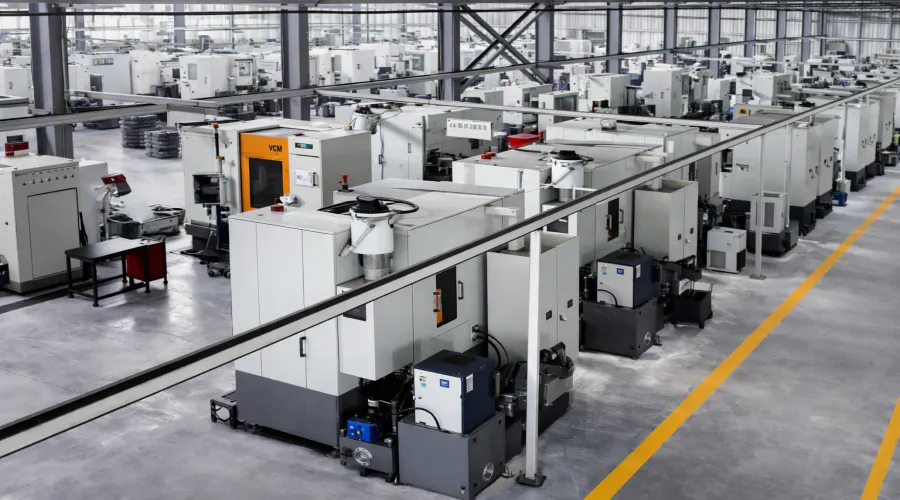
The manufacturing sequence for a precision right angle planetary gearbox intended for printing machine use differs substantially from what is acceptable in general industrial applications. Each element of the manufacturing process directly affects the final backlash, noise, and stiffness values — the three parameters that most directly determine print quality outcomes when the gearbox is integrated into a transport roller drive.
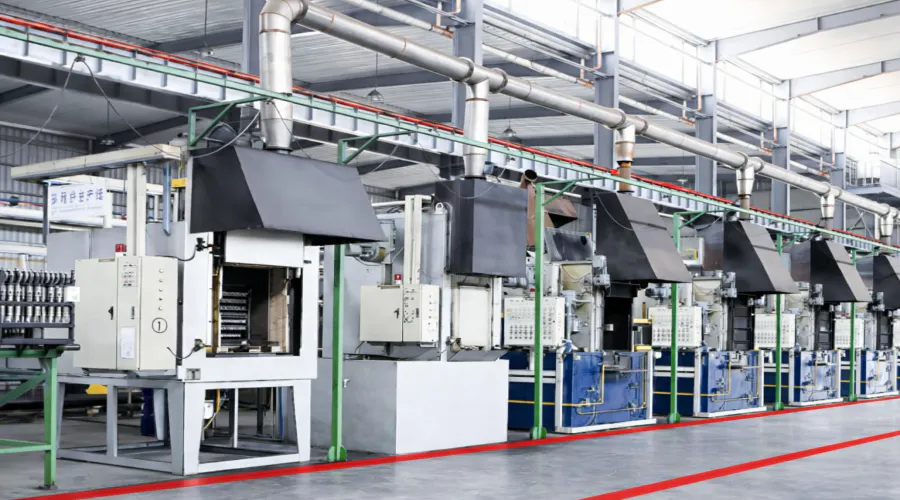
Gear blanks start as hot-forged billets of 20CrMnTi or 20CrMo alloy steel. Forging rather than bar stock ensures the grain structure of the finished gear tooth is continuous from root to tip, which is critical for fatigue resistance at the high cycle counts seen in continuously running press transport systems. After rough turning, the blanks go through hobbing or gear shaping to create the preliminary tooth form. This is followed by carburizing in a controlled-atmosphere furnace — typically a methane/nitrogen atmosphere at 920°C for 6 to 8 hours — which diffuses carbon into the tooth surface to the required case depth of 0.4 to 0.9 mm while preserving the tough core.
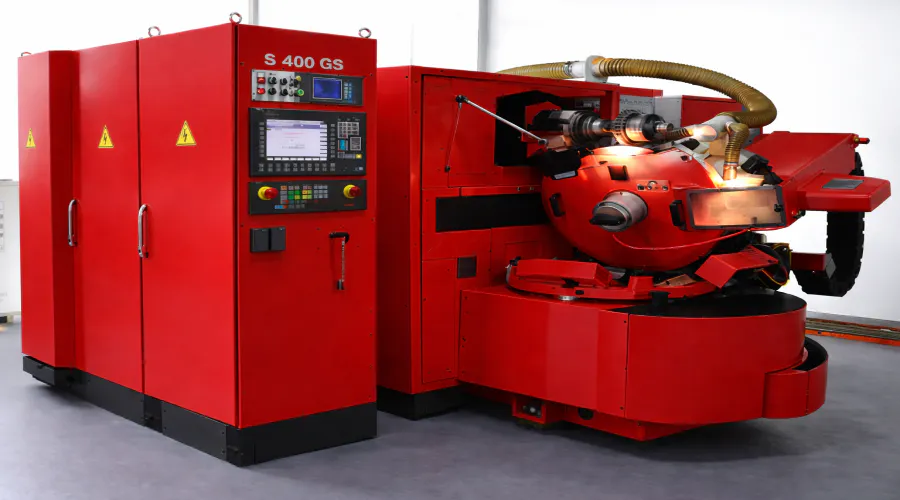
After quench hardening, distortion of the gear blank is inevitable at the micron level. Precision grinding on a CNC gear grinding machine restores the tooth form to ISO accuracy Grade 5 or Grade 4 — the standard required for low-backlash servo gearbox applications. The bevel gear set undergoes lapping as a matched pair after grinding to further reduce the composite pitch error that contributes most strongly to noise in the mesh. Planet pin bores are jig-bored to a positional tolerance of ±0.003 mm to ensure equal load sharing across all planet gears — a tolerance that cannot be achieved on conventional machining centers and requires a dedicated jig boring or coordinate boring machine.
Assembly takes place in a temperature-controlled environment. Planet carrier preload is set by selective fitting of shim stacks, and the final backlash value is measured on a rotary backlash tester before the housing is closed. Units intended for the compact right angle planetary gearbox Colombia market and broader Latin American automation sector undergo full rotation testing at rated speed prior to shipment.
6. Material System: Standard vs. High-Performance Configuration
One of the clearest ways to understand the performance gap between a commodity right angle gearbox and a precision unit specified for printing machine paper feed is to compare the material stack systematically. The table below sets this out side by side.
| Component | Standard Industrial Gearbox | High-Performance Printing Grade |
|---|---|---|
| Housing | Cast grey iron, as-cast bore | Aluminium alloy (small frame) or ductile iron (large frame), CNC-machined all bores |
| Sun Gear | 45# carbon steel, induction hardened | 20CrMnTi alloy steel, carburized and ground to Grade 5 |
| Planet Gears | 40Cr, hobbed to Grade 8 | 20CrMo, carburized, ground to Grade 5; set-matched for equal tooth contact |
| Ring Gear | 42CrMo, broached, no post-hardening grind | 42CrMo, through hardened, internal tooth ground |
| Bevel Gear Set | Cast steel, cut but not lapped | 20CrMnTi, precision cut and lapped as matched pair |
| Planet Carrier | Cast iron, standard pin tolerances | Ductile iron or steel, jig-bored to ±0.003 mm positional tolerance |
| Bearings | Standard deep groove ball, C3 clearance | Full needle roller (planets); preloaded angular contact or tapered roller (output); P5 or P4 tolerance class |
| Shaft Material | 45# carbon steel, turned | 42CrMo alloy steel, ground to h6/k6 tolerance for interference fits |
| Oil Seals | NBR rubber, standard lip | FKM (Viton) or PTFE-coated lip; suitable for synthetic lubricants and solvent-bearing print room atmospheres |
7. Surface Treatment
The print room environment combines several corrosion drivers that a standard industrial gearbox surface finish is not designed to handle: ink solvent vapors, fountain solution aerosols in offset press environments, paper dust particles with abrasive silica content, and the periodic cleaning chemicals used to maintain press cleanliness. Surface treatment selection for a right angle planetary gearbox intended for printing machine installation must account for all of these simultaneously, not just one.
Aluminium alloy housings receive hard anodizing to a thickness of 15 to 25 microns — not the decorative anodizing common in consumer products, but type III sulfuric acid hard coat anodizing that produces a surface hardness of 400 to 600 HV. This layer resists the surface erosion from paper dust and provides a barrier against the weak acids present in fountain solutions. The anodized surface is then sealed with PTFE impregnation in premium units to reduce friction against any sliding contact at the flange faces. For ductile iron housings in larger frame sizes, an electroless nickel plating of 20 to 35 microns is applied over a phosphate conversion coating base, giving corrosion resistance equivalent to ASTM B117 (salt spray) performance of 500 hours or more. External fasteners are zinc-nickel plated to Class 8 corrosion resistance rather than the standard zinc plating found on commodity gearboxes.
Internal gear surfaces — beyond the hardened tooth faces — receive a phosphate manganese conversion coating prior to assembly. This coating serves two functions: it provides a micro-porous surface that retains initial lubricant film during run-in, reducing the risk of adhesive wear in the first 50 operating hours, and it provides a degree of corrosion protection against any moisture that enters the housing through the breather during temperature cycling.
8. Environmental Rating & Operating Conditions in Printing Environments
The IEC 60529 IP (Ingress Protection) rating system provides a standardized framework for describing the sealing performance of a gearbox housing. For paper transport gearbox installations, IP54 is the minimum practical rating: the first digit (5) indicates protection against dust ingress sufficient to prevent harmful accumulation, while the second digit (4) indicates splash resistance from any direction — relevant for the water and cleaning fluid exposure that occurs during press washing cycles. In web offset press environments where damping water spray is significant, IP65 (fully dust-tight, jet-wash resistant) is the preferred specification.
Beyond the IP rating, humidity resistance of the lubricant and seal materials matters significantly in tropical print room environments common to Colombia and other Andean countries, where ambient relative humidity regularly exceeds 80%. Synthetic grease based on lithium complex or polyurea thickeners retains its viscosity and corrosion-inhibiting properties in these conditions better than mineral oil greases. The FKM lip seal, specified in printing-grade units, resists swelling in the presence of aromatic solvents found in UV-cure ink systems without the stiffness penalty that PTFE seal lips exhibit at temperatures below 20°C — a consideration for printing plants in Bogotá operating at altitude-driven ambient temperatures of 14°C to 18°C.
9. Five Key Advantages for Printing Machine Paper Transport
1. Sub-3-Arcmin Backlash for Register Accuracy
Angular error in the roller drive shaft translates directly into sheet misregistration. A high precision right angle planetary gearbox with backlash below 3 arcmin reduces lateral sheet wander to below 0.05 mm on a 500 mm roller span — sufficient for 4-color process work without mechanical register correction intervention.
2. High Torque Density in a Compact Frame
The high torque right angle planetary gearbox delivers rated torques up to 480 Nm within a 142 mm flange frame — a power density that no helical parallel-axis unit can match at the same size. Press frames are tight; minimizing gearbox envelope without sacrificing torque reserve is not optional, it is a design requirement.
3. 90-Degree Output for Transverse Roller Shafts
The 90-degree gear transmission of a right angle design eliminates the need for external bevel gears, angle brackets, or articulated shaft couplings between the motor and the roller shaft. Fewer external interfaces mean fewer alignment-sensitive joints, lower vibration generation, and simpler maintenance procedures for press room technicians in Bogotá or Medellín operations.
4. Universal Motor Adaptation Flange
A compliant input flange with elastomeric coupling element absorbs torsional shock from servo motor commutation events and compensates minor shaft misalignment — up to 0.1 mm radial and 0.5° angular — without transmitting bending load to the sun gear shaft. This design detail extends sun gear bearing life significantly compared to rigid flange connections used in lower-grade units.
5. Sealed Lifetime Lubrication
High-quality synthetic grease filling in standard configurations eliminates scheduled oil changes for the operational life of the gearbox — typically exceeding 20,000 hours. In press environments where scheduled downtime is tightly managed and oil change intervals are often missed in practice, a maintenance-free gearbox design directly reduces unplanned failure risk and total cost of ownership over a 10-year press lifecycle.
10. Typical Operating Conditions in Paper Feed and Sheet Transport
Sheet-fed offset paper transport presents a duty cycle profile unlike most other precision drive applications. Rather than continuous rotation at constant speed, the transport rollers operate in a semi-continuous mode governed by press impression cycle frequency. At 10,000 sheets per hour, each sheet-grip, transport, and release event takes approximately 360 milliseconds. Rollers accelerate, hold speed through the transport zone, and decelerate — then hold still for sheet transfer — all within that window. The corresponding gearbox input shaft cycles through approximately 28 rotations per second at maximum speed, returning to near-zero velocity at each sheet handoff.
This cyclic loading pattern imposes higher dynamic tooth loading than the nominal torque rating suggests. The ratio of peak torque to rated torque during the acceleration phase of each cycle can reach 1.8 to 2.2 times rated torque, which is why the peak torque rating of a right angle planetary gearbox — typically specified as 2× rated for a 2-second duration — must be evaluated against the actual acceleration torque requirement, not just the steady-state transport load. Undersizing the gearbox to match the steady-state torque alone while ignoring acceleration transients is one of the most common specification errors in press drive train design, and it almost invariably results in premature gear tooth pitting or planet pin bearing fatigue.
Web press environments differ: the gearbox sees continuous rotation at constant speed for hours, but the torque is higher due to the tension loads in the web. Temperature rise inside the gearbox housing can reach 40°C above ambient at sustained full-load operation — an important consideration when specifying lubricant viscosity grade and seal material for web press right angle gear drive installations.
11. Typical Failure Modes & Diagnostic Indicators
Tooth Pitting (Surface Fatigue)
The most frequent failure mode in under-rated or improperly lubricated units. Visible as small craters on the tooth face, concentrated near the pitch line. Diagnostic indicator: gradual increase in noise level over weeks, often accompanied by metal particles in the lubricant visible on a magnetic drain plug. Root cause analysis almost always implicates either lubricant contamination, overload from undersized specification, or extended overdue oil service.
Planet Pin Bearing Fatigue
Full needle roller bearings on planet pins are small-diameter, high-speed elements that rely on adequate lubricant film for their calculated life. When grease ages or becomes contaminated with paper dust — possible if the lip seal has degraded — the rollers run dry, generating white etching cracks in the inner race and ultimately spalling failure. Early indicator is a characteristic periodic “tick” noise at the planet rotation frequency, distinguishable from bevel mesh noise by frequency analysis.
Bevel Gear Tooth Wear
Hypoid and spiral bevel gear sets are sensitive to bearing preload changes. When the angular contact or tapered roller bearings supporting the bevel pinion shaft lose their preload — due to bearing wear or shim relaxation — the bevel mesh contact pattern shifts from the theoretical optimum, concentrating load on the tooth edges. The result is accelerated wear at the tooth edges and increasing noise at the bevel mesh frequency. This failure mode is particularly relevant in high-speed paper transport applications where bevel mesh frequency falls within the frequency range of machine noise monitoring systems.
Seal Failure and Lubricant Loss
In print room environments, FKM lip seals can be degraded by prolonged contact with UV ink solvents if the press cleaning protocol involves spraying solvent near the gearbox housing. Solvent penetration causes seal lip swelling, then hardening and cracking in a sequence typically spanning 6 to 18 months. The symptom is a light film of grease or oil residue on the housing exterior near the shaft entry. Left unaddressed, lubricant loss leads to bearing and gear damage within weeks.
Backlash Growth Over Service Life
As planet gear tooth faces and ring gear tooth flanks wear, the theoretical backlash of the gearbox increases gradually. In most applications this is acceptable within the elastic limit of the system stiffness. In servo-driven paper transport applications, however, the servo controller’s position loop gain is set based on the initial backlash measurement. When backlash increases beyond 2× the initial value, the controller begins to exhibit hunting behavior — small oscillations around the target position — which manifests in the paper register as a periodic misprint pattern tied to the servo control cycle frequency.
12. Regulatory Framework: Gearbox and Machinery Standards by Region
The regulatory environment surrounding power transmission components and printing machinery varies considerably by region. For procurement teams in Colombia and throughout Latin America sourcing a right angle planetary gearbox supplier in Colombia or importing units from overseas, understanding the applicable standards framework prevents compliance delays at customs and reduces liability exposure.
Colombia (ICONTEC / RETIE): Colombia’s national standards body ICONTEC adopts ISO and IEC standards by direct transposition in most machinery categories. For electrical machinery and servo-driven systems, the Reglamento Técnico de Instalaciones Eléctricas (RETIE) governs the electrical safety aspects of the drive train, including the motor and controller — the gearbox itself is a mechanical component and falls under general machinery safety principles aligned with ISO 12100 (risk assessment) and ISO 13857 (safety distances for guarding). Printing machines imported into Colombia require INVIMA or DIAN technical documentation confirming conformance to applicable standards; CE marking is widely accepted as evidence of conformance.
European Union (CE / Machinery Directive 2006/42/EC): Printing machines and their sub-assemblies placed on the EU market require CE marking. Gearboxes incorporated into CE-marked machine assemblies must be accompanied by a Declaration of Incorporation confirming conformance with the Essential Health and Safety Requirements of Annex I. ISO 6336 (gear strength calculation) and ISO 76 (bearing rating life) are the harmonized calculation standards most directly relevant to gearbox design verification.
United States (OSHA / AGMA Standards): OSHA 29 CFR 1910.212 establishes machine guarding requirements applicable to exposed rotating shafts on gearboxes in production environments. AGMA 6013 and AGMA 2001 provide the gear design and rating standards most widely used by US printing machine OEMs for specifying gearbox performance. AGMA 9 through AGMA 12 gear accuracy grades correspond roughly to ISO 1328 Grades 5 through 8, providing a translation reference when evaluating gear quality specifications from suppliers outside the US market.
Brazil (ABNT): Brazil’s ABNT NBR standards for industrial machinery safety largely parallel the ISO framework. For press room installations in São Paulo or Porto Alegre, ABNT NBR 14009 (machines and equipment — general safety) and the NR-12 Norma Regulamentadora governing machine safety in the workplace are the primary compliance references. Gearboxes used in guarded assemblies do not require individual Brazilian certification, but the complete machine assembly must comply with NR-12 before placement in service.
ISO International Standards: ISO 1328-1 defines gear accuracy grades for cylindrical gears; the equivalent for bevel gears is ISO 17485. ISO 281 governs dynamic bearing load rating and service life calculation. ISO 9001:2015 quality management system certification from the gearbox manufacturer provides an independent assurance of design and manufacturing process consistency — an important factor for procurement teams evaluating a right angle gear drive manufacturer for long-term supply agreements.
13. Recommended Configuration for Printing Machine Paper Transport
Based on the operating conditions, failure mode analysis, and material system review above, the following configuration guidelines apply to most sheetfed and web offset paper transport applications when specifying a right angle planetary gearbox. These represent experience-based recommendations rather than universal rules — each application should be verified against actual load data before final specification.
Ratio Selection
Select the ratio such that the motor operates at 60–80% of its rated speed at maximum paper transport velocity. This preserves dynamic headroom for acceleration phases and keeps the motor in its highest efficiency operating region. Two-stage ratios in the 20:1 to 50:1 range cover most sheetfed transport applications.
Torque Rating
Size the gearbox to the acceleration torque peak, not the continuous transport torque. Apply a service factor of 1.5 to 1.8 to the calculated peak torque to account for shock loads from sheet jam clearing events and emergency stops. Undersizing to the continuous torque value is the leading cause of premature failure in servo press transport drives.
Precision Grade
For 4-color process work and digital press transport requiring register accuracy below ±0.1 mm: specify high-precision grade, backlash ≤3 arcmin. For single-color commercial print and transport-only roller drives where registration is maintained by mechanical guides: standard precision grade at ≤8 arcmin backlash is adequate and more cost-effective.
Output Shaft Configuration
For direct roller shaft coupling: specify a keyed solid output shaft with h6 tolerance for a fitted key connection. For hollow-shaft configurations on retrofit installations where the press roller shaft passes through the gearbox: specify a hollow bore output with locking ring or spline connection to avoid the alignment sensitivity of keyed shrink-fit joints on small diameter shafts.
All configurations listed are available as custom right angle planetary gearbox options. If your press drive application falls outside standard catalogue parameters — non-standard ratios, special flange patterns, wash-down environments, or integration with older press mechanical systems — our engineering team works directly with your press maintenance engineer or OEM to develop a matched specification. For the precision planetary gearbox Colombia automation market and Andean region customers, we maintain application support contacts who can visit on-site for drive train assessment.
Looking for the inline version of our planetary reducer series for servo feed axis applications? See our full planetary gearbox product range including inline planetary, right angle bevel planetary, and custom precision configurations — or explore our planetary gearbox ratio selection guide for help matching stage count and gear ratio to your press drive requirements.
14. Application Scenarios Beyond Standard Paper Transport
Sheet Gripper Bar Drive (Sheetfed Offset)
Transfer drum gripper bars require precise angular positioning at high cycle rates. A 90-degree planetary gearbox with backlash below 3 arcmin and torsional stiffness above 30 Nm/arcmin ensures that gripper open/close timing remains within specification throughout the production run, preventing double-sheet feed and tail-edge damage on heavy stock.
Ink Form Roller Drive (Offset and Flexo)
Form rollers oscillate axially while rotating — a compound motion that generates significant radial loads on the gearbox output shaft. The high radial shaft load rating of a properly specified right angle planetary gearbox (up to 4,800 N for 142 mm frame) accommodates this combined load without the shaft deflection that causes ink stripe formation and density variation across the printed sheet.
Web Tension Control (Gravure / Flexo)
Web press nip rollers used for tension zone control require servo-accurate speed matching between adjacent press sections. A right angle planetary gear drive with matched backlash and stiffness across all nip stations minimizes the inter-zone tension variation that causes web wander, print repeat error, and in extreme cases, web breaks in lightweight substrate printing.
Digital Press Media Transport (Inkjet / Electrophotographic)
High-speed inkjet press transport systems present a unique combination of high positioning accuracy demand with very low torque — the opposite of offset press conditions. A compact right angle planetary gearbox in the 60 to 80 mm frame range, with precision bearings and low-friction FKM seals, provides the control bandwidth needed for closed-loop transport without the thermal influence that larger units would introduce into the media temperature-sensitive print zone.
Label & Narrow-Web Press Registration Drive
Label press servo register systems in Colombia’s growing packaging print sector rely on right angle gear transmission to couple registration correction servo motors to impression cylinder shafts. The compact envelope of a 60 mm frame high torque right angle planetary gearbox fits within the narrow-web press drive train without requiring modification to the press frame — critical for aftermarket servo register retrofit projects on older mechanical register presses.
WorkShop

15. Related Products & System Compatibility
A right-angle planetary gearbox is one component in a precision drive system. Optimizing the complete system — motor, gearbox, coupling, and controller — requires that all elements are selected for compatibility with each other, not just for individual component performance. We supply the key components of the full servo drive train, enabling a one-stop specification and supply approach that simplifies procurement and reduces integration risk.
Servo Motor
Matching the inertia ratio between servo motor and gearbox-reflected load is critical for servo loop stability in paper transport applications. Our servo motor range is characterized by shaft dimensions, inertia values, and flange patterns that are pre-matched to our right angle planetary gearbox input flanges — eliminating the adapter calculations and coupling selections that add time to drive system engineering. Frame sizes cover the full range of press drive applications from 60 W auxiliary axes to 5 kW main transport motors.

Inline Planetary Reducer
Where the 90-degree output orientation is not required — such as in direct inline paper transport roller drives or conveyor feed axes — our inline precision planetary reducer series provides the same gear quality and backlash specification as the right angle units, in a coaxial layout. Using the same gear quality standard and bearing specification across both inline and right angle units in the same press simplifies your spare parts stocking program and ensures consistent service life across the drive train.

Frequently Asked Questions
Q1. How does a right angle planetary gearbox actually work inside a printing press paper transport system?
The gearbox receives rotation from a servo motor through its input flange, steps the speed down through one or two planetary gear stages, then redirects the output shaft rotation through 90 degrees via a spiral bevel or hypoid bevel gear pair. In a paper transport roller drive, this means the motor can mount parallel to the press frame while the roller shaft runs transverse to the paper path — a spatial arrangement that most press frames require. The planetary stages provide high torque density and the torsional stiffness needed for accurate servo position control; the bevel stage provides the direction change without the efficiency loss of a worm gear or the alignment complexity of an external bevel coupling arrangement.
Q2. What is the recommended maintenance schedule for a right-angle planetary gear drive installed on a web offset press running two shifts daily?
For a grease-filled sealed-for-life unit on a two-shift web press operation: inspect the housing exterior and output shaft seal for grease weeping every three months. If the unit is of the oil-filled type (common in larger frame sizes and hypoid bevel configurations), check oil level at six months and change at the earlier of 5,000 hours or 24 months of operation. Measure backlash at the output shaft annually using a dial indicator — record and trend the values over time rather than waiting for a threshold to be crossed. Check input shaft coupling element condition annually; the elastomeric insert in many servo coupling designs has a service life shorter than the gearbox itself and is often the first component to require replacement. If the press operates under high wash-down frequency, inspect the input and output shaft seals visually at each six-month service interval.
Q3. What planetary gearbox ratio should I specify for a sheetfed offset press paper transport drive running at 10,000 sheets per hour?
Start with the roller surface speed requirement at maximum press speed and work backwards to the motor speed. For a typical sheetfed transport roller with a 60 mm diameter running at 10,000 sph, the roller circumferential speed is approximately 800 mm per second, giving a roller shaft speed of roughly 250 RPM. If the servo motor is rated at 3,000 RPM, the required ratio is approximately 12:1. In practice, a 14:1 or 16:1 ratio is specified to keep the motor below 85% of rated speed at maximum sheet velocity, preserving headroom for acceleration peaks. A two-stage right angle planetary gearbox in the 16:1 to 20:1 range covers this application range cleanly.
Q4. Which right angle gear drive configuration works best for high-speed web press tension control in tropical climates like Colombia?
For web press tension control in high-humidity tropical environments, the recommended configuration is a two-stage right angle planetary gearbox with FKM lip seals, IP65 rated housing, and synthetic polyurea-based grease lubrication. The FKM seals resist solvent and ink vapor degradation better than standard NBR seals; the IP65 rating handles the press wash-down cleaning typical of food-packaging print plants; and polyurea grease maintains its viscosity characteristics in the 30°C to 35°C ambient temperatures common to Colombian coastal cities and valley locations throughout the year. The higher humidity also argues for hard-anodized aluminium housing or electroless nickel-plated iron housing to prevent surface oxidation from moisture condensation during press shutdown periods.
Q5. What certifications should I look for when choosing a right angle gear drive manufacturer for precision Colombian automation projects?
ISO 9001:2015 quality management system certification is the minimum baseline for any precision gearbox manufacturer supplying industrial automation projects. For the Colombian market, this is the certification most directly recognized by procurement departments and is required documentation for many institutional and government-funded automation projects. Beyond ISO 9001, look for documented gear accuracy measurement reports per ISO 1328 or DIN 3962, bearing selection documentation referencing ISO 281 rating life calculations, and test records for backlash and torsional stiffness from the manufacturing inspection stage. CE marking on the gearbox or its associated drive system is relevant if the end machine will be exported to the EU or if the Colombian customer’s quality management system requires CE documentation for installed components. Manufacturers who provide these documents on request — rather than only on special demand — have typically invested in the measurement equipment and procedures needed to consistently produce the specification they publish.
Q6. What are the typical signs of planetary gear reverse direction backlash that indicate my gearbox needs replacement on a sheetfed press?
The most obvious sign is a visible paper registration shift that is repeatable in pattern — specifically, a shift that appears at the beginning of each new acceleration cycle and disappears after the first sheet passes through. This is the servo controller following the backlash dead zone at each direction reversal point. Secondary indicators include a “clunk” audible at each gripper bar handoff point, increasing servo position error readings in the drive controller diagnostics, and on color presses, a consistent color-to-color offset that tracks with machine cycle rate rather than with environmental or temperature conditions. When backlash readings measured at the output shaft exceed 2.5 times the original specification value, replacement is the most cost-effective path forward.
Q7. How does a right angle planetary gearbox differ from a standard worm gearbox for printing machine transport applications?
The three practical differences that matter most in printing applications are efficiency, backlash, and input speed capability. A worm gearbox at a 20:1 ratio typically delivers 50 to 70% efficiency — the rest is converted to heat in the worm mesh. A right angle planetary gearbox at the same ratio achieves 92 to 95% overall efficiency. On a press running 16 hours per day, the energy cost difference is real. Backlash: worm gearboxes inherently accumulate backlash as the worm thread and wheel tooth face wear together; precision floor is typically 10 to 15 arcmin after initial break-in. A precision right angle planetary gearbox holds 3 to 5 arcmin throughout its service life. Input speed: worm gearboxes are thermally limited at input speeds above 1,500 RPM in most frame sizes. Right angle planetary designs handle 3,000 RPM input continuously, matching the speed range of modern servo motors directly without derating.
Q8. When is a 90 degree heavy duty planetary gearbox the right choice for a Colombian printing plant automation upgrade versus a standard precision unit?
The 90 degree heavy duty planetary gearbox — typically meaning a ductile iron housing, larger bearing cross-sections, and an increased peak torque rating — is appropriate when the transport application involves high-inertia roller systems, thick board stock requiring significant draw force, or frequent emergency stop events that generate torque spikes above twice the rated value. Large-format commercial offset presses with roller widths above 1,200 mm fall into this category, as do corrugated board and carton transport systems at packaging print plants. For standard commercial sheetfed printing on stock below 400 gsm, the standard precision aluminium-housing unit is sufficient and more cost-effective for the application.
Editor: PXY