
1. Why the Tilt Axis of a 5-Axis Rotary Table Is One of the Most Demanding Drive Applications in Precision Machining
Five-axis CNC machining centers are the backbone of complex part production across the aerospace, medical device, mould and die, and automotive sectors. The rotary table at the heart of a 5-axis configuration provides the additional A and C axes (or B and C, depending on the machine layout) that allow complex sculptured surfaces to be machined in a single setup. Of the two rotary axes, the tilt axis — the one that tilts the table toward and away from the spindle — is consistently the more mechanically demanding drive point. It carries the full combined weight of the table, the workpiece, and the rotational inertia of the entire assembly, and it must resist the variable cutting forces generated by interrupted cuts, deep pocketing, and high-feed milling strategies at any angle between 0° and 120°.
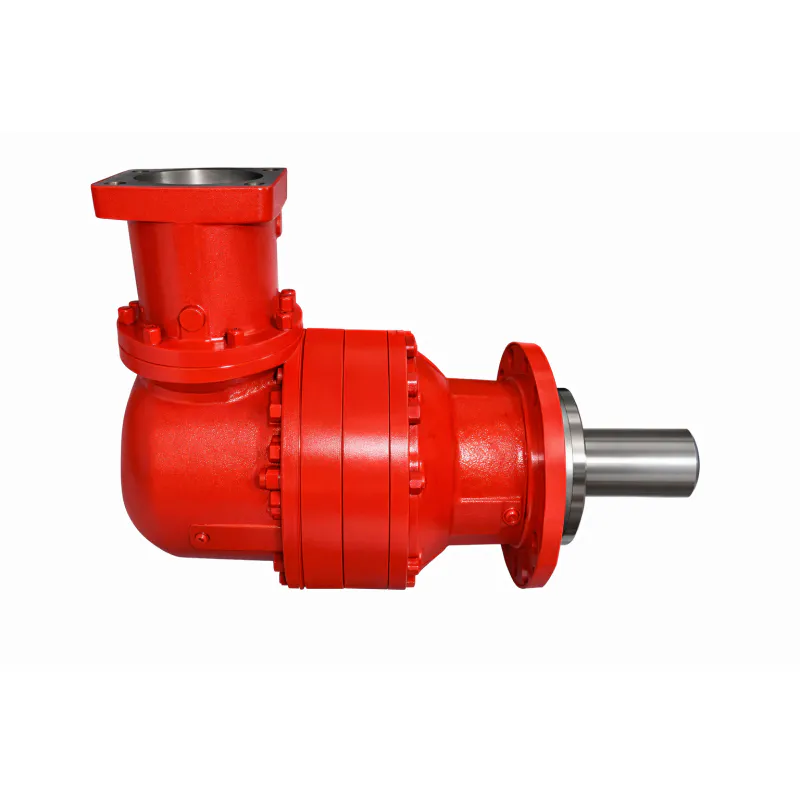
A right angle planetary gearbox addresses this challenge by enabling the servo motor to be mounted parallel to the table surface — rather than projecting axially below or above the tilt axis — while still delivering torque directly into the tilt shaft through a 90-degree bevel output stage. This layout is not simply an assembly convenience. It is what allows the machine builder to keep the rotary table envelope compact, position the servo motor within the machine frame without restricting the table’s angular travel range, and achieve the torsional stiffness values that angular positioning accuracy demands. Backlash below 1 arc-minute and torsional rigidity above 50 Nm per arc-minute are the threshold values the machine tool industry uses to define acceptable tilt axis drive performance, and these values are achievable only with precision-grade bevel-planetary configurations — not with worm gear or standard bevel gear arrangements.
This article covers the mechanical principles, structural specifications, material choices, and recommended configurations for right angle planetary gearbox units deployed as tilt axis drives on 5-axis rotary tables. It is written for mechanical design engineers, CNC machine tool integrators, and procurement engineers at precision machining facilities in Colombia and across the Andean manufacturing sector who need technically grounded information to support drive selection decisions.
2. Motion Mode: The Mechanics of Tilt Axis Positioning
The tilt axis on a 5-axis rotary table is a positioning axis, not a continuous-rotation axis. Its motion profile is characterised by: precise moves to a commanded angle at moderate angular velocity (typically 10–60 rpm at the tilt shaft); a hold phase at the commanded angle during cutting, during which the drive must maintain position against cutting force reactions without any angular displacement; and a return or repositioning move to the next commanded angle before the following cut. This stop-position-hold cycle is repeated hundreds of times per part program, and the accumulated angular positioning error across those cycles is what determines the geometric accuracy of the finished part.
The implications for gearbox selection are specific and non-negotiable. During the hold phase, the cutting force transmitted back through the workpiece, fixture, and table to the tilt shaft creates a torque load on the output of the gearbox. If the gearbox has measurable backlash — meaning there is a small angular gap between the driven and driving flanks of the gear teeth — the output shaft will rotate by the backlash amount under this torque before the gear tooth engagement arrests further movement. For a right angle planetary gearbox with backlash of 1 arc-minute, this displacement at a 300 mm workpiece radius is approximately 0.087 mm — already near the boundary of acceptable tolerance for aerospace-grade parts machined to IT6 or IT7 standards. Any backlash above 1 arc-minute produces positioning errors that exceed the tolerance budget of precision components, which is why the sub-arc-minute backlash specification is a hard requirement for tilt axis applications, not a performance preference.
Torsional rigidity — expressed in Nm per arc-minute — governs a related but distinct characteristic. Even with zero backlash, a gearbox with low torsional rigidity will deflect angularly under torque load in proportion to the applied moment. A torsional rigidity below 50 Nm/arc-minute means that a cutting force moment of 50 Nm at the tilt shaft produces a positioning error of 1 arc-minute — approximately 0.087 mm at 300 mm radius. The combination of sub-1 arc-minute backlash and greater-than-50 Nm/arc-minute torsional rigidity defines the minimum performance envelope for a precision right angle planetary gearbox in this application.
3. Structure Type: Precision Bevel-Planetary Configuration
The structural type used for 5-axis tilt axis drives is an integrated spiral bevel plus planetary arrangement — the same category used in other right-angle drive applications, but manufactured to a fundamentally higher precision standard. The designation “precision grade” in the machine tool context means gear tooth profiles ground to DIN 4 or DIN 5 tolerance class (versus DIN 6 to 8 for general industrial applications), preloaded angular contact bearings at the input and output shafts to eliminate axial play, a housing manufactured from high-grade ductile iron or aluminium alloy held to positional tolerances of ±0.01 mm on the bearing bore centres, and assembly performed under controlled temperature conditions to ensure that the preload and backlash values measured at final inspection are representative of the values the unit will deliver in service.
The planetary stage in a tilt axis right angle planetary gearbox is a single-stage or two-stage epicyclic arrangement with three or four planet gears. The key structural detail that differentiates a precision machine tool unit from a standard industrial unit is the planet carrier design. In a precision unit, the planet gear shafts are pressed into the carrier with a controlled interference fit, the planet gear bore-to-shaft clearance is held to less than 3 µm, and the planet gear axial position is set by precision ground spacers — not by the shaft shoulder tolerance alone. This level of dimensional control in the planetary stage is what delivers the low output torque ripple that is essential for smooth servo-controlled positioning moves: if the planet gears do not share load equally due to dimensional variation, the output torque varies cyclically at the planet mesh frequency, creating a periodic positioning error that appears as a sinusoidal wave superimposed on the servo position trace.
The spiral bevel output stage is the most precision-intensive subassembly. The bevel pinion and ring gear are lapped as a matched pair — the pinion is run against the ring gear in a lapping machine with an abrasive compound until the tooth contact pattern covers the full tooth flank at a consistent depth. This lapping process simultaneously reduces surface roughness, improves tooth profile accuracy, and establishes the running backlash of the matched pair. After lapping, the pair is kept together as a unit and must never be interchanged with bevel gears from a different matched set, which is why the gearbox assembly is tested and shipped as a complete unit rather than as separable subassemblies.
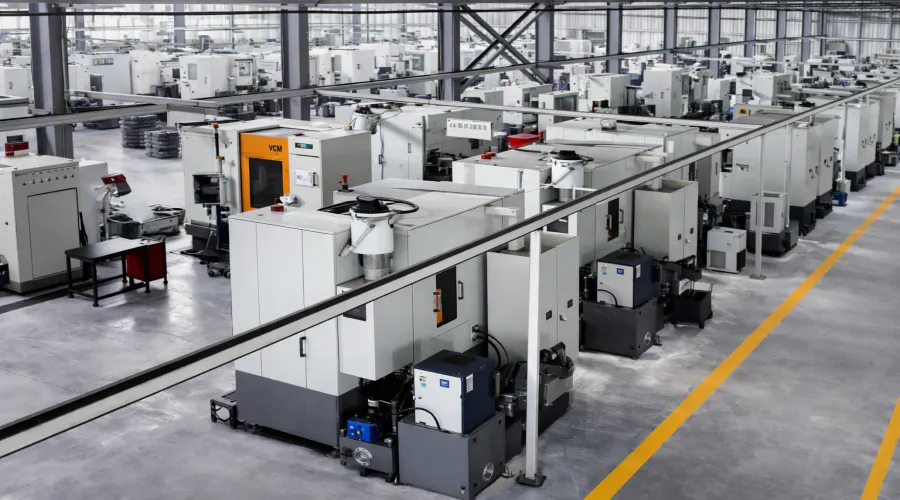
4. Five Key Advantages for CNC Rotary Table Tilt Axis Applications
These advantages reflect the engineering rationale documented in machine tool design literature and confirmed in field performance data from 5-axis machining centers operating across Colombia’s precision manufacturing sector, in the automotive tooling clusters of Medellín, and in aerospace subcontract facilities in Bogotá and Cali.
01 — Sub-Arc-Minute Backlash
A precision right angle planetary gearbox for tilt axis service achieves backlash values of 1 arc-minute or below in single-stage configurations and 3 arc-minutes or below in two-stage units. These values are measured at the output flange under a defined torque reversal test protocol and represent the true positioning ambiguity the CNC controller must manage. Sub-arc-minute backlash is what allows the CNC controller to command absolute angular positions without backlash compensation algorithms — a significant simplification of the servo tuning process and a reduction in the machine’s sensitivity to servo parameter drift over the equipment’s operational life.
02 — High Torsional Rigidity Under Cutting Loads
With torsional rigidity values exceeding 50 Nm/arc-minute in precision-grade configurations — and reaching 200+ Nm/arc-minute in larger frame sizes — the right angle planetary gearbox maintains its commanded angular position within measurement error even under the peak cutting force moments generated by high-feed milling and deep-slot operations. For a precision machining operation targeting IT6 cylindricity on a titanium aerospace component, the difference between 40 Nm/arc-minute and 100 Nm/arc-minute torsional rigidity at the tilt axis is directly visible in the cylindricity deviation measurement of the finished part.
03 — Motor Parallel to Table Surface
The 90-degree bevel output stage allows the servo motor input axis to run parallel to the table surface, while the tilt shaft axis is perpendicular to it. This layout keeps the servo motor within the machine column footprint, eliminating the motor overhang that a collinear drive arrangement would require below or above the table trunnion. For a compact 5-axis machining center with a 500 mm table — the most common size in the Colombian precision machining sector — this layout reduces the machine’s footprint by 80–120 mm in the Y-axis direction compared to a direct-drive or collinear planetary arrangement.
04 — Low Output Torque Ripple
The precision planetary stage distributes the input torque across three or four planet gears with equal load sharing, producing an output torque wave with ripple amplitude below 1.5% of mean torque across the full speed range. This low ripple value is critical for smooth, controllable servo positioning moves at low angular velocities — the 0.1–3 rpm range at which the tilt axis operates during contoured simultaneous 5-axis moves. High torque ripple in this speed range causes a “cogging” response in the servo drive that produces surface finish marks on contoured surfaces at the spatial frequency corresponding to the ripple period.
05 — Compact Flange Integration
Precision right angle planetary gearboxes for machine tool integration are manufactured with output flanges and pilot diameters held to h6 or H6 tolerance class, allowing direct bolted mounting to the machine tool tilt shaft without intermediate adapter plates. The input flange matches standard IEC B5 or machine-tool-specific flange configurations for direct servo motor attachment. This dimensional precision at the interface means that the gearbox contributes no additional runout or squareness error beyond its own manufacturing tolerances — typically less than 15 µm TIR at the output flange face — which matters in a machine tool context where every µm of drive error contributes directly to machined part geometry.
5. Working Principle: How Does a Right Angle Planetary Gearbox Work in a Tilt Axis Context
Understanding how does a right angle planetary gearbox work in a machine tool tilt axis starts with recognising that it is a two-stage torque multiplication and direction-change device operating under a fundamentally different load regime than most industrial drive applications. The servo motor drives the sun gear at the centre of the first planetary stage. Three or four planet gears orbit the sun gear within a fixed ring gear (annulus), and their carrier outputs a reduced-speed, multiplied-torque rotation. In a precision machine tool unit, the planet gear bearings are needle roller bearings with very low radial clearance — typically 2–4 µm — rather than the standard ball bearings used in industrial planetary stages, because the needle roller configuration produces lower radial compliance, contributing directly to the torsional rigidity of the stage.
The reduced-speed rotation from the planetary carrier feeds into the spiral bevel stage. The input bevel pinion meshes with the bevel ring gear on the tilt shaft at 90 degrees. In a precision gearbox, this bevel mesh is the primary contributor to the gearbox’s angular positioning accuracy — the lapped tooth contact pattern distributes the tangential gear force over a large proportion of the tooth flank area, minimising the local elastic deflection under load that would otherwise appear as torsional compliance in the output. The planetary gearbox ratio in a tilt axis application is typically selected to match the servo motor’s rated speed (2,000–4,000 rpm) to a tilt shaft speed of 20–80 rpm, giving ratios in the range of 25:1 to 200:1 depending on the two-stage configuration selected.
The question of how does a planetary gearbox work in terms of load distribution is particularly relevant for interrupted cutting loads. When a milling cutter exits a cut — as happens dozens of times per revolution in face milling — the tangential cutting force drops to zero instantaneously. The tilt axis drive must absorb this load removal without allowing the table to shift angularly, which requires that the gear tooth contact on both the planetary and bevel stages remain loaded in one direction throughout the cutting operation. This is achieved through the servo motor’s torque-biasing function, which maintains a small constant torque preload on the tilt axis even during no-cut phases, ensuring that the gear meshes remain single-flank loaded and that backlash gaps never open.
For standard product configurations and ratio tables for machine tool tilt axis applications, the planetary gearbox product range provides dimensional drawings and torque-rigidity curves for each standard frame size.
6. Technical Specifications – Precision Right Angle Planetary Gearbox (Tilt Axis CNC Application)
The 20 parameters below represent a precision-grade right angle planetary gearbox configuration suitable for a 5-axis rotary table tilt axis on a machining center with a 500–630 mm table, carrying workpiece weights up to 150 kg. Custom configurations including hollow-shaft outputs, through-shaft encoder integration, and non-standard ratios are available on request.
| Parameter | Value / Specification |
|---|---|
| Gearbox Type | Spiral Bevel + 2-Stage Planetary (integrated) |
| Output Shaft Angle | 90° |
| Available Ratios | 25:1, 32:1, 40:1, 50:1, 64:1, 80:1, 100:1 |
| Rated Output Torque (T2n) | 120 – 800 Nm (frame size 060–120) |
| Peak Output Torque (T2peak, 400 ms) | Up to 3× T2n |
| Backlash (standard) | ≤ 1 arc-min |
| Backlash (precision option) | ≤ 0.5 arc-min (specify at order) |
| Torsional Rigidity | 50 – 200 Nm/arc-min (frame size dependent) |
| Transmission Efficiency | ≥ 95% (two-stage, full load) |
| Input Speed (max.) | 4,500 rpm |
| Gear Profile Tolerance | DIN 5 (ISO 1328 Grade 5) |
| Planet Gear Bearing Type | Full-complement needle roller |
| Output Shaft Bearing | Preloaded angular contact (paired) |
| Output Flange Runout (TIR) | ≤ 0.015 mm |
| Housing Material | GGG-50 ductile iron (nodular), stress-relieved |
| Gear Material | 18CrNiMo7-6, case-carburised and ground |
| Lubrication | Synthetic PAO ISO VG 150, lifetime-sealed |
| Noise Level (no-load, 3,000 rpm input) | ≤ 62 dB(A) |
| Service Life (L10h, rated load) | ≥ 20,000 hours |
| Overall Dimensions (L × W × H) – frame 090 | 210 mm × 168 mm × 168 mm |
Custom ratios, hollow-shaft outputs, and precision grades below 0.5 arc-minute backlash are available on request. Contact the application engineering team for tilt axis sizing calculations specific to your rotary table mass, inertia, and cutting force envelope.
7. Manufacturing Structure
Producing a precision right angle planetary gearbox for machine tool tilt axis service involves a manufacturing process that differs from standard industrial gearbox production at nearly every stage. The differences are not simply a matter of tighter tolerances on the same operations — they reflect a fundamentally different approach to dimensional stack-up management, heat treatment distortion control, and assembly process verification.
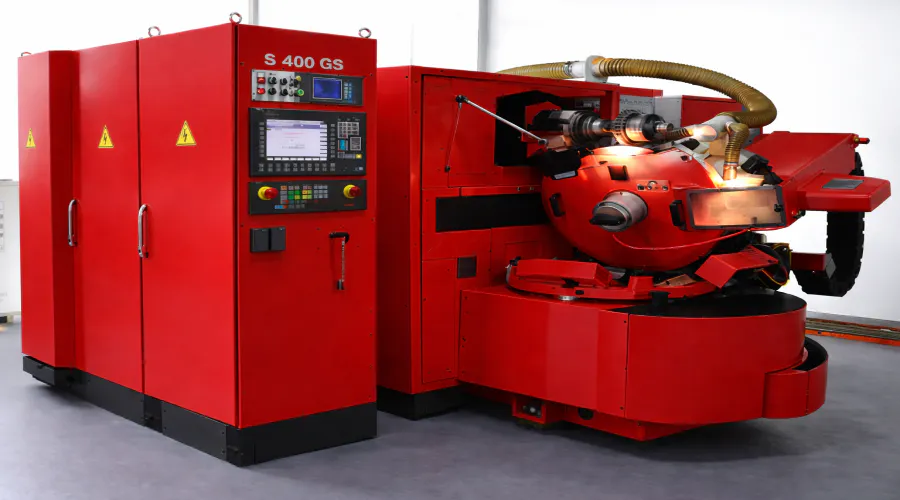
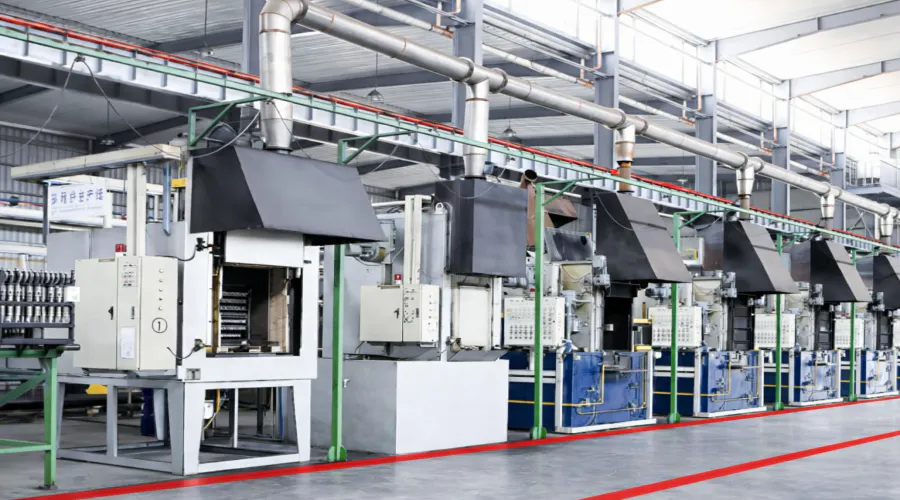
Gear blanks are cut from certified 18CrNiMo7-6 alloy steel with full material traceability to heat certificate. After rough machining to leave 0.8–1.2 mm of grinding stock on tooth flanks and critical bore surfaces, the blanks undergo case-carburising in a controlled-atmosphere furnace to achieve a case depth of 0.8–1.4 mm at a surface carbon concentration of 0.75–0.85% C, followed by oil quenching and a sub-zero treatment at -80 °C to eliminate retained austenite. The sub-zero treatment is a step that is skipped in standard industrial gear manufacturing but is mandatory in precision machine tool gears because retained austenite is dimensionally unstable — it transforms to martensite over time at room temperature, causing a dimensional change that shifts the gear’s tooth profile out of tolerance during its operational service life. After sub-zero treatment, all gear components are finish-ground on CNC gear-grinding machines to a profile tolerance of DIN 4 or 5, with 100% pitch accuracy measurement on a CNC gear measuring centre as part of the standard inspection protocol.
Housing components are produced from GGG-50 nodular cast iron, chosen for its combination of vibration-damping capacity (important for reducing resonant amplification of high-frequency cutting vibrations transmitted back through the tilt shaft), dimensional stability, and machinability at the close tolerances required for the bearing bore and register surfaces. After rough machining, castings are stress-relieved at 550–600 °C to remove residual machining stresses before finish boring — a step that prevents dimensional drift of the bore during the machine tool’s service life from stress relaxation under the operating loads. Assembly is performed in a climate-controlled room at 20 ±1 °C, with all components stabilised to room temperature before assembly to ensure that the backlash and preload values set during assembly are representative of the values at operating temperature.

8. Material System: Standard Industrial Gearbox vs. Precision CNC Machine Tool Gearbox
The material and process differences between a standard industrial right angle planetary gearbox and a precision machine tool unit are significant enough to produce a two- to three-fold difference in backlash, torsional rigidity, and service life under the specific load profile of a tilt axis application. The comparison below covers the critical components and their machine tool vs. industrial specifications.
| Component | Standard Industrial Unit | Precision CNC Machine Tool Unit |
|---|---|---|
| Gear Steel Grade | 20MnCr5, case-hardened | 18CrNiMo7-6, carburised + sub-zero treated |
| Gear Profile Tolerance | DIN 6–8 | DIN 4–5, 100% gear-measuring-centre verified |
| Planet Gear Bearings | Deep groove ball, standard clearance | Full-complement needle roller, 2–4 µm clearance |
| Output Shaft Bearings | Single ball bearing, no preload | Preloaded angular contact pair, P5 class |
| Housing | Cast iron or aluminium, standard bore tolerance | GGG-50 ductile iron, stress-relieved, ±0.01 mm bore |
| Bevel Gear Set | Hobbed, not matched-pair lapped | Matched-pair lapped, 100% contact pattern verified |
| Backlash Measurement | Not measured, assumed from gear tolerance class | 100% measured and documented per unit |
| Assembly Environment | General workshop | Climate-controlled, 20 ±1 °C |
| Output Flange TIR | Not specified / 0.05–0.10 mm typical | ≤ 0.015 mm, documented in test certificate |
9. Surface Treatment
Surface treatment in a precision CNC machine tool gearbox serves two primary purposes: corrosion protection of the internal gear and bearing components against the cutting fluid mist that penetrates the machine enclosure, and dimensional stability of the housing bore and register surfaces over the machine tool’s operational service life. These purposes are served by different treatments applied to different components.
The gear tooth flanks of the planetary and bevel stages receive no additional surface treatment beyond the case-hardened and ground condition. Adding a coating — even a thin PVD or DLC coating — to precision gear teeth introduces a dimensional change that shifts the tooth profile out of the DIN 4 or 5 tolerance class to which it was ground. For precision machine tool gears, the case-hardened and ground surface itself — with a surface hardness of 58–62 HRC and a ground surface roughness of Ra 0.4–0.6 µm — is the correct final condition. The hardness provides the wear resistance needed for the stop-position-hold duty cycle, and the surface roughness is within the range where elasto-hydrodynamic lubrication film formation is reliable at the low sliding velocities present in precision bevel gear mesh during tilt axis positioning moves.
Housing external surfaces are protected with a two-component epoxy primer and a polyurethane topcoat in the machine tool grey that is standard for the CNC machine builder’s colour palette. Internal housing surfaces — the bearing bore inner faces and the gear cavity walls — are phosphate-treated to provide a corrosion-inhibiting base coat that does not change the dimensional tolerances of the precision bores. The output flange and pilot diameter are left in the finish-machined condition (Ra 0.8 µm, no coating) because any coating on a precision fit surface introduces an unpredictable thickness variation that compromises the pilot location accuracy.
Shaft seal lip contact surfaces on the input and output shafts are ground to Ra 0.2–0.4 µm and hardened to HV 58+ to minimise the seal lip wear rate at the point of dynamic contact. The seals themselves are FKM compound — resistant to the cutting oil and coolant chemistry encountered in machining center environments — with a garter spring to maintain consistent lip contact force across the full operating temperature range of -10 °C to +90 °C.
10. Environmental Grade for Machine Tool Service
The environment inside a CNC machining center enclosure is more chemically aggressive than is sometimes appreciated by drive engineers specifying gearboxes for the tilt axis. During cutting, the coolant system delivers 5–20 L/min of water-miscible cutting fluid at pressures up to 80 bar (in high-pressure through-spindle coolant systems) to the cutting zone. The coolant mist produced by this delivery penetrates every unsealed cavity in the machine enclosure, including the space around the rotary table trunnion where the tilt axis gearbox is mounted. The coolant chemistry — typically a semi-synthetic or synthetic emulsion at 5–10% concentration, with biocide and rust inhibitor additives — is mildly alkaline (pH 8.5–9.5) and contains surfactants that reduce the surface tension of the liquid, enabling it to penetrate smaller gaps than plain water.
| Zone | Description | Minimum IP Rating | Seal Specification |
|---|---|---|---|
| Tilt Axis Trunnion Zone | Direct coolant splash from cutting zone | IP65 minimum; IP67 preferred | FKM triple-lip, labyrinth pre-seal |
| Motor Connection Zone | Coolant mist, oil aerosol from spindle | IP65 | FKM input seal, motor adapter sealed flange |
| Servo Drive Cabinet | Coolant mist vapour, EMI from cutting | IP54 cabinet (drive inside) | N/A – sealed enclosure required |
| Chip Conveyor Area | Chip impingement, cutting fluid splatter | IP54 | Standard NBR seals acceptable |
Note: High-pressure coolant (over 40 bar) at the tilt axis trunnion requires the addition of a labyrinth seal pre-stage upstream of the primary FKM seal to prevent direct coolant jet impingement on the seal lip, which accelerates seal lip wear independently of the seal material chemistry.
11. Operating Characteristics of the 5-Axis Tilt Axis Drive
The tilt axis of a 5-axis rotary table operates under a load regime that combines two fundamentally different mechanical demands within the same drive unit. The positioning demand requires low backlash, high torsional rigidity, and smooth torque transmission across a wide speed range including very low angular velocities. The clamping/holding demand during cutting requires that the drive maintain its position against sustained and impact-type cutting force moments without relaxing or oscillating under the closed-loop servo control system’s response.
The inertia mismatch ratio between the servo motor rotor and the total tilt axis inertia (table + workpiece + gearbox output stage) is a key design parameter. For a 5-axis table with a 150 kg workpiece at 300 mm radius, the tilt axis inertia can reach 13.5 kg·m². A standard servo motor rotor inertia for this application is typically 0.002–0.015 kg·m². The right angle planetary gearbox ratio of 50:1 or 80:1 reduces the reflected inertia seen at the motor shaft by the square of the ratio — meaning a 50:1 gearbox reduces the tilt axis inertia by a factor of 2,500 to approximately 0.0054 kg·m² reflected to the motor, which is within the 1:3 to 1:10 inertia matching range that servo drives require for stable positioning response without excessive overshoot.
The duty cycle is characterised by rapid positioning moves (0.5–5 seconds duration) followed by holding phases of 30–180 seconds during cutting. The heat generated during the positioning moves is dominated by the motor’s copper losses (I²R) rather than by gearbox mechanical losses, which are below 5% of transmitted power in a two-stage precision unit. The holding phase generates minimal gearbox heat because the motor runs at near-zero speed. This intermittent thermal profile means that the gearbox operating temperature remains well below 60 °C in normal CNC service even without forced cooling, which keeps the PAO lubricant viscosity within the optimal range for the bevel and planetary gear mesh EHD film thickness throughout the machine’s operating schedule.
12. Typical Failure Modes and Diagnostic Indicators
Failure in a precision right-angle planetary gearbox on a tilt axis application typically develops gradually and can be detected through the CNC machine’s own servo monitoring data before catastrophic failure occurs. The failure modes below reflect documented maintenance histories from 5-axis machining centers operating in the precision manufacturing sector across Colombia, Mexico, and Brazil.
Backlash Growth – Bevel Gear Wear
The most common failure mode in high-cycle tilt axis service is a gradual increase in output backlash caused by wear on the bevel gear tooth flanks. This wear is accelerated when the torque-biasing preload on the servo is insufficient to maintain single-flank engagement during interrupted cutting, allowing the gear flanks to impact alternately as the cutting force reverses. Diagnostic indicator: the CNC servo’s following error increases progressively over weeks; the machine’s ball-bar test shows a greater reversal error at the tilt axis compared to the C-axis or linear axes. Action: measure backlash directly at the tilt flange with a dial indicator and compare to the original commissioning measurement documented in the gearbox test certificate.
Output Bearing Fatigue – Overloaded Tilt Axis
Fatigue spalling of the preloaded angular contact output bearings occurs when the tilt axis is repeatedly operated with workpiece overhangs or depths of cut that exceed the tilt axis torque budget. The first symptom is increased vibration at the tilt shaft during positioning moves — detectable as a roughness in the servo velocity feedback signal at the bearing defect frequency. If ignored, the spalling debris contaminates the gear oil, initiating abrasive wear at the bevel and planetary gear meshes. Action: reduce workpiece overhang, verify that the peak cutting torque at the tilt shaft does not exceed the gearbox’s rated T2peak value, and inspect the tilt axis bearing preload at the next scheduled maintenance interval.
Coolant Ingress – Seal Degradation
Coolant penetration past the tilt shaft output seal contaminates the gear oil, reducing its film-forming capacity and introducing water-induced oxidation of the bearing steel surfaces. The contaminated oil typically emulsifies to a milky appearance detectable at the oil inspection port or sample point. Coolant ingress is accelerated by high-pressure coolant delivery aimed directly at the trunnion area without an external seal cover, by NBR seals that have softened in contact with cutting fluid chemistry, and by worn seal lips caused by operation with insufficient labyrinth pre-sealing. Prevention: verify the trunnion seal specification at installation; add an external labyrinth cover if the machine design allows direct coolant impingement on the trunnion face.
Planet Pin Fretting – Under-Lubrication
Fretting corrosion at the planet pin-to-carrier interface develops when the gearbox is installed at an orientation that allows the PAO lubricant to pool away from the planetary stage, leaving the needle roller bearings running in a reduced-lubricant condition. The needle roller bearing contact stress in a precision planetary stage — typically 2,000–3,500 MPa — is above the threshold where inadequate lubrication film quickly produces fretting damage on the pin surface. Diagnostic indicator: a periodic knock at the planet mesh frequency during slow-speed positioning moves. Prevention: confirm at installation that the gearbox mounting orientation is within the oil-level envelope specified in the product’s dimensional drawing, and use an oil level indicator if the machine design places the gearbox in a non-standard orientation.
13. Recommended Configuration for 5-Axis Tilt Axis Service
The configuration parameters below represent the current best-practice specification for a precision right angle planetary gearbox on a 5-axis rotary table tilt axis at a machining center with a 500–630 mm table and workpiece mass up to 150 kg. These recommendations are applicable to CNC machining centers operating in Colombia’s precision manufacturing sector and are consistent with the technical requirements documented in ISO 10791-6 (5-axis machining center performance tests) and ISO 230-1 (machine tool geometric accuracy assessment).
Gear stages: Two-stage planetary plus spiral bevel output. Two planetary stages are preferred over one for this application because they achieve the required high ratios (50:1 to 100:1) within a smaller housing diameter than a single stage, and the two-stage arrangement distributes the total gear set power density more evenly, reducing the peak Hertzian contact stress on any single gear mesh point.
Ratio selection: Match the servo motor rated speed (2,000–3,000 rpm) to a tilt shaft speed of 30–60 rpm for rapid positioning. A 50:1 or 64:1 ratio covers most 5-axis table configurations with 2,500–3,000 rpm motors. Verify inertia match: reflected inertia at the motor shaft should be within 1:1 to 1:5 of the motor rotor inertia for stable servo response without excessive gain detuning.
Backlash grade: Standard backlash (≤ 1 arc-minute) is sufficient for general precision machining to IT7 standards. For aerospace components to IT6 or below, specify the reduced-backlash option (≤ 0.5 arc-minute) and document the measured backlash value from the gearbox test certificate in the machine’s calibration record.
Output interface: Specify the output flange in the h6/H6 tolerance class matching the tilt shaft bore. For hollow-shaft output configurations — where the tilt shaft passes through the gearbox output — confirm the through-shaft diameter and the output bearing’s axial load capacity, which must accommodate the preload from the tilt shaft clamp mechanism in addition to the cutting force moment.
Lubrication: PAO ISO VG 150 synthetic gear oil, lifetime-sealed. Do not substitute mineral gear oil in a precision machine tool unit — the higher oxidation stability of PAO is required to maintain the oil’s viscosity-pressure index over the 20,000+ hour service life, and the lower pour-point of PAO (below -45 °C) ensures correct lubricant flow during cold-start conditions in air-conditioned machining facilities in high-altitude Colombian cities such as Bogotá (2,600 m above sea level).
Mounting verification: After installation, measure the output flange face runout with a dial indicator at the machine tool’s nominal room temperature (20 ±2 °C) and record the value. Repeat at the 500-hour service interval. A progressive increase in runout — more than 5 µm beyond the as-installed value — indicates developing output bearing damage and warrants gearbox inspection before the next production run on critical-tolerance parts.
For product selection and dimensional drawings specific to your servo motor flange and table interface dimensions, visit our precision right angle planetary gearbox catalogue or contact the technical team for a configured application proposal.
14. Application Scenarios
The right angle planetary gearbox in machine tool and precision automation applications extends beyond the 5-axis tilt axis to a wider family of high-precision positioning drives. The scenarios below illustrate the range of machine tool and automation contexts where the same bevel-planetary architecture meets demanding accuracy and rigidity requirements.
5-Axis Rotary Table Tilt Axis – Machining Centers
The primary application covered in this article. The right angle planetary gearbox enables the servo motor to be mounted parallel to the table surface on 5-axis trunnion tables, delivering sub-arc-minute backlash and high torsional rigidity to the tilt axis for complex contour machining of aerospace, medical, and mould tooling components. Precision machining facilities in Colombia’s Medellín and Bogotá industrial zones use this configuration for titanium and aluminium aerospace structural part production on medium-sized 5-axis machining centers with 500–800 mm table diameters.
Indexing Rotary Tables – 4th Axis CNC Turning/Milling
Four-axis CNC turning and milling centers use a simpler rotary table with a single A-axis for part indexing between faces. The right angle planetary gearbox in this application operates at higher angular velocities than the 5-axis tilt axis — up to 20 rpm continuous — and requires high torsional rigidity to resist the face milling loads on large, flat surfaces. A compact right angle planetary gearbox Colombia machine tool integrators use for 4th axis additions on existing 3-axis machining centers is typically a single-stage configuration at 20:1 to 40:1 ratio, providing a balance of compact housing diameter and sufficient torque for mid-size part indexing work.
Grinding Machine Workhead Drive
Cylindrical and profile grinding machines require a workhead that rotates the workpiece at very low angular velocities (1–30 rpm) with extreme torque smoothness to avoid leaving feed marks on the ground surface. The right angle planetary gearbox in a grinding workhead application must deliver output torque ripple below 1% to avoid producing periodic surface finish non-uniformities at the spatial frequency corresponding to the ripple period at the workpiece diameter. A high torque right angle planetary gearbox at 80:1 ratio driving a grinding workhead with a 3,000 rpm servo motor produces a workhead speed of 37.5 rpm with the low ripple amplitude achievable from a three- or four-planet precision stage.
CMM and Measurement System Rotary Stages
Coordinate measuring machines (CMMs) and optical measurement systems use precision rotary stages for scanning complex geometric features. The right angle gear drive in a CMM rotary stage application must achieve positioning repeatability below 2 arc-seconds — significantly tighter than machining center requirements — which drives the specification toward zero-backlash preloaded configurations with extremely high torsional rigidity relative to the applied measurement probe force. These applications typically use the smallest frame sizes with the highest precision grades and benefit from the 90 degree gear transmission layout that allows the drive motor to be positioned outside the measurement volume.
Laser Cutting and Welding Rotation Axes
Laser cutting and welding systems for tube and pipe processing use a rotary chuck to rotate the workpiece under the laser head. The right angle planetary gearbox in this application serves as the pipe rotation drive, delivering continuous-rotation torque at speeds of 5–120 rpm depending on the workpiece diameter and the laser process parameters. The right angle transmission layout allows the drive motor to be positioned alongside the pipe axis rather than collinearly, keeping the pipe loading end clear for the chuck mechanism and the pipe infeed conveyor system.
15. Regulatory and Standards Framework for CNC Machine Tool Drive Components
Precision machine tool equipment — including the drive components installed in CNC machining centers — is subject to a layered regulatory and standards framework that varies by market. Understanding which standards apply in Colombia and in the export markets served by Colombian precision manufacturers is important for procurement engineers who need to confirm that their drive component specifications are consistent with the machine tool’s regulatory status.
Colombia – ICONTEC NTC & SGSST Requirements
In Colombia, CNC machine tools are regulated under the Sistema de Gestión de Seguridad y Salud en el Trabajo (SGSST) framework established by Decreto 1072/2015 and Resolución 0312/2019, which require that all production machinery meets applicable safety standards and that equipment operators are trained for the specific hazards associated with the machine type. Machine tool buyers in Colombia’s precision machining sector are increasingly requiring that CNC equipment — and its key drive subassemblies — carries CE marking per the EU Machinery Directive as a proxy for demonstrated safety compliance, even for equipment intended for domestic use. ICONTEC NTC standards reference ISO machine tool standards for geometric accuracy and performance assessment.
EU – Machinery Directive 2006/42/EC & ISO 10791
The EU Machinery Directive 2006/42/EC applies to machine tools exported from Colombia to European markets and to machine tools assembled in Latin America by subsidiaries of European machine tool builders. Drive subassemblies — including the right angle planetary gearbox — must be documented in the machine’s technical file as conforming to the applicable essential health and safety requirements. The relevant machine tool accuracy standard, ISO 10791-6, specifies the acceptance tests for 5-axis machining centers including the tilt axis positioning accuracy and repeatability measurements that directly depend on the tilt axis gearbox’s backlash and torsional rigidity performance.
United States – ANSI/ASME B5.54 & OSHA Machine Safety
In the United States, 5-axis machining centers are subject to OSHA 29 CFR 1910.212 (machine guarding) and ANSI/ASME B5.54 (methods for performance evaluation of computer numerically controlled machining centres), which includes axis reversal error and backlash measurement protocols that depend on the tilt axis gearbox performance. For precision machining companies in Colombia supplying parts to North American aerospace customers under AS9100 quality management certification, the 5-axis machining center’s axis accuracy documentation — including the tilt axis performance tests — is part of the AS9100 audit evidence package reviewed by aerospace customer quality teams.
ISO 230 Series – Machine Tool Geometric Accuracy
ISO 230-1 (geometric accuracy under no-load conditions) and ISO 230-2 (thermal effects) are the primary international standards governing the geometric performance assessment of machine tools including 5-axis rotary tables. ISO 230-7 specifically addresses the accuracy of rotary axes. The tilt axis backlash and reversal error values measured per ISO 230-7 are directly traceable to the gearbox backlash specification — a gearbox backlash of 1 arc-minute produces a tilt axis reversal error of at least 1 arc-minute in ISO 230-7 testing, which is typically the upper acceptance limit for a precision-grade 5-axis machining center. Purchasing a replacement gearbox without specifying and verifying the backlash to the original ISO 230-7 test result is a frequent source of machine performance degradation after gearbox replacement.
ISO 9283 – Industrial Robot Gearbox Standards
While ISO 9283 applies formally to industrial robots rather than machine tools, it is referenced in the machine tool industry as the methodology for measuring gear transmission accuracy and repeatability in servo-driven rotary axes. The test protocols in ISO 9283 for measuring angular positioning accuracy, backlash, and reversal error are directly applicable to precision right angle planetary gearbox units used in rotary table tilt axis applications, and many gearbox manufacturers publish unit-level test data in ISO 9283 format to allow direct comparison of measured performance against the machine tool builder’s axis accuracy requirements.
WorkShop
16. Related Products & System Compatibility
A precision tilt axis drive is a system — servo motor, reducer, and right angle gearbox must work together as a dimensionally and dynamically matched unit to achieve the angular positioning accuracy that 5-axis precision machining demands. Sourcing these elements from a single manufacturer eliminates the dimensional interface uncertainties and inertia mismatch calculations that arise when combining components from different suppliers, and provides a unified technical support point for commissioning and fault diagnosis. Our motor and reducer product ranges are engineered to integrate directly with our right angle planetary gearbox line, sharing matched flange dimensions, compatible inertia values, and documented torque-speed compatibility across the full product range.
Precision Servo Motor – Matched Drive Input
Our precision servo motor range is engineered for direct IEC B5 flange mounting to the right angle planetary gearbox input without adapter plates, with rotor inertia values matched to the inertia ratios achievable at 50:1 and 64:1 tilt axis ratios for 5-axis table loads of 50–200 kg. Available in frame sizes 60 through 130 with resolver or encoder feedback, the motors are rated for operation in the coolant-mist environment of a machining center enclosure. Pairing a matched servo motor with the precision right angle gearbox and providing both as a configured assembly simplifies the machine builder’s commissioning process.

Inline Planetary Reducer – Pre-Stage for High Ratios
For tilt axis applications requiring ratios above 100:1 — such as very slow-speed precision indexing tables with heavy fixtures — our inline planetary reducer can be installed as a pre-stage between the servo motor and the right angle gearbox input. This three-component arrangement achieves combined ratios of 500:1 to 2,000:1 while maintaining the sealed, matched-flange architecture of the overall drive assembly. The inline reducer’s output flange matches the right angle gearbox input flange in the same dimensional series, so the combined package integrates as a single unit with no alignment hardware between stages.

Frequently Asked Questions
Q1. How does a right angle planetary gearbox work as a tilt axis drive on a 5-axis CNC machining center used for aerospace parts in Medellín Colombia?
In a 5-axis tilt axis application, the servo motor drives the planetary stage input sun gear. The planetary stage reduces the motor speed by the selected ratio (typically 50:1 to 100:1) and multiplies the torque proportionally. The planetary carrier output then drives the spiral bevel input pinion, which meshes with the bevel ring gear on the tilt shaft at exactly 90 degrees. The bevel stage redirects the reduced-speed rotation from the motor axis (parallel to the table surface) to the tilt shaft axis (perpendicular to the table), enabling the motor to be mounted within the machine column without projecting below or above the table travel range. For aerospace part machining in Medellín, the key performance requirements are backlash below 1 arc-minute and torsional rigidity above 50 Nm/arc-minute — both achievable with a two-stage precision right angle planetary gearbox in the 50:1 to 80:1 ratio range.
Q2. What planetary gearbox ratio should I use for a 5-axis tilt axis with a 3,000 rpm servo motor and a target tilt speed of 50 rpm on a CNC machine in Bogotá?
Required ratio = 3,000 / 50 = 60:1. Standard available ratios closest to this are 50:1 and 64:1. At 50:1, the tilt speed at 3,000 rpm motor speed is 60 rpm — slightly above target, correctable by setting the servo’s maximum speed to 2,500 rpm via the drive parameter. At 64:1, the tilt speed is 46.9 rpm — slightly below target, achievable at rated motor speed. For a precision machining application in Bogotá where the servo parameter setup should remain at the motor’s rated speed to preserve torque headroom at full inertia load, the 64:1 ratio is typically the better choice. Confirm inertia match: at 64:1 ratio, the tilt table inertia reflected to the motor shaft is divided by 4,096 — verify this reflected value against the motor’s rotor inertia to confirm the ratio is within the 1:1 to 1:5 recommended inertia matching range for the servo drive being used.
Q3. Which right angle planetary gearbox supplier in Colombia provides precision CNC machine tool grade units with documented backlash certificates and fast lead times for replacement parts?
When evaluating a right angle planetary gearbox supplier Colombia for precision CNC machine tool applications, the documentation requirements are more specific than for general industrial procurement. Confirm that the supplier provides: a unit-level test certificate documenting measured backlash (not a catalogue range), output flange TIR, and no-load noise level; material traceability for gear steel to heat certificate level; and dimensional drawings in STEP format compatible with common CAD systems for integration into the machine’s design verification. Lead time for standard precision grades is typically 10–18 working days for units shipped by air freight to Bogotá or Medellín. Custom configurations (non-standard ratio, hollow shaft, special flange) require 4–6 weeks. Request a proforma invoice with HS code documentation for Colombian import clearance as part of the initial quotation.
Q4. What is the difference between a high torque right angle planetary gearbox and a worm gear right angle unit for a CNC rotary table tilt axis application?
The difference matters significantly in a precision CNC application. A worm gear right angle unit offers a self-locking property and low cost, but has mechanical efficiency of only 40–85% (compared to 94–97% for a bevel-planetary unit), which means the motor must deliver more current for the same output torque — generating more heat and consuming more energy. More critically for tilt axis service, worm gears have higher backlash (typically 4–15 arc-minutes), lower torsional rigidity (because the worm gear mesh is inherently more compliant than a bevel gear mesh under torque reversal), and lower service life under the oscillating positioning loads of a 5-axis tilt axis. Precision CNC machine tool builders universally use bevel-planetary or hypoid-planetary configurations for tilt axis drives — not worm gears — for exactly these reasons.
Q5. How do I get a quote for a compact right angle planetary gearbox Colombia CNC machine tool project with custom hollow shaft output and precision backlash below 0.5 arc-minute?
For a precision quotation for a hollow-shaft compact right angle planetary gearbox for a CNC machine tool project in Colombia, provide the following application data: required ratio or target tilt shaft speed at the servo motor’s rated speed; rated and peak output torque at the tilt shaft; hollow shaft through-bore diameter and length; output flange pilot diameter and bolt circle; motor frame size and IEC flange designation; required backlash grade (standard ≤ 1 arc-min or precision ≤ 0.5 arc-min); and the coolant type and pressure at the tilt trunnion location. With this information, the application team can confirm whether the required specifications fall within a standard catalogue configuration or require a custom build, and provide a formal quotation with delivery timeline within two working days.
Q6. What does torsional rigidity mean for a right angle planetary gearbox and how does it affect the accuracy of a 5-axis CNC tilt axis during interrupted cuts?
Torsional rigidity in a right angle planetary gearbox is expressed in Nm per arc-minute. It represents the angular deflection of the output shaft relative to the input shaft that occurs when a torque is applied — the higher the torsional rigidity, the smaller the angular deflection for a given torque load. In a 5-axis CNC tilt axis during an interrupted cut, the cutting force drops to zero each time the milling cutter exits a cut face, then re-applies when it re-enters. Each re-entry applies a torque pulse to the tilt axis. A gearbox with 50 Nm/arc-min torsional rigidity deflects by 1 arc-min when a 50 Nm pulse arrives — approximately 0.087 mm at 300 mm workpiece radius. If this deflection is within the CNC closed-loop servo response time, the servo will correct it; if the cutting frequency is faster than the servo bandwidth, the deflection accumulates as a surface finish error on the machined wall. Higher torsional rigidity — 100 or 200 Nm/arc-min — reduces this deflection and extends the cutting frequency range over which the servo remains in control.
Q7. When should I specify a 90 degree planetary gearbox heavy duty configuration instead of a standard precision grade for a large-format 5-axis machining center in Colombia?
Specify a 90 degree planetary gearbox heavy duty configuration when the tilt axis application involves workpieces heavier than 200 kg, machining of hard materials such as titanium, Inconel, or hardened steel at aggressive material removal rates, or table configurations with high fixture offsets that produce large overturning moments at the tilt shaft. Heavy-duty configurations use oversized output bearings (to handle the increased overhung and thrust loads), increased housing wall thickness (to reduce housing compliance under peak cutting moments), and in some cases a modified planetary carrier with four rather than three planet gears (distributing the increased load across a greater tooth contact area). For large-format 5-axis machining centers with 800 mm or larger tables — common in Colombia’s oil and gas equipment manufacturing sector in Barrancabermeja and Cartagena — the heavy-duty specification is the default rather than the exception.
Q8. How often should a right angle planetary gearbox on a 5-axis CNC tilt axis be inspected or replaced in a high-production precision machining facility in Cali?
A precision right angle planetary gearbox on a 5-axis tilt axis in continuous production should have its backlash measured — using a dial indicator at the tilt flange with the motor energised for preload and then de-energised — at 6-month intervals or every 2,000 operating hours, whichever comes first. Record each measurement against the commissioning baseline documented in the gearbox test certificate. If the measured backlash has increased by more than 0.5 arc-minutes from the baseline value, or if the machine’s ISO 230-7 tilt axis reversal error has increased beyond 1.0 arc-minute on the quarterly geometric check, the gearbox should be scheduled for replacement at the next available machine stop window. Waiting for audible failure symptoms before replacing a tilt axis gearbox in a high-production facility typically means discovering the problem mid-production run on a critical-tolerance part — an outcome that is far more costly than a planned replacement at the first measurement warning.
Q9. What are the main cost drivers for a right angle planetary gear drive torque Colombia 5-axis machining center upgrade project, and how can I justify the investment against a standard industrial gearbox?
The cost difference between a precision machine tool grade right angle planetary gearbox and a standard industrial unit of the same torque rating typically ranges from 2× to 4× in initial unit cost. The justification for the premium is built from three measurable cost avoidances. First, scrap and rework cost: a standard gearbox with 4–8 arc-minute backlash on a 5-axis tilt axis produces part errors that exceed IT7 tolerance on complex contoured surfaces, generating scrap on high-value aerospace or mould tooling components where a single part can represent significant value. Second, calibration frequency: a machine running with high tilt axis backlash requires more frequent geometric recalibration — each calibration event represents machine downtime and technician time. Third, customer audit risk: a tilt axis that fails ISO 230-7 acceptance criteria puts the facility’s customer qualification at risk. In a Colombian precision machining facility operating under aerospace customer qualification, one failed customer audit typically costs more in re-qualification effort than the cost difference between three years of standard gearbox replacements and one precision unit.
Editor: PXY