
Industrial robots are, at their mechanical core, a cascade of precision reducers. Every joint in a six-axis articulated robot — and every axis of a SCARA unit — is a precision gearbox problem. The servo motor turning at 2,000 to 4,000 RPM must be reduced to the slow, high-torque rotary output that moves the robot arm, while preserving the angular positioning accuracy that makes repeatable tool center point (TCP) positioning at ±0.05 mm possible across thousands of cycles per day. The inline (coaxial) planetary gearbox — a configuration where the input and output share the same rotational axis — is the architecture that satisfies this set of requirements better than any alternative in current production robot joint design.
Understanding the inline planetary gearbox in the robot joint context requires going beyond basic gear reduction theory. The performance parameters that matter most — backlash, torsional stiffness, lost motion, torsional compliance, and moment load capacity — interact with each other and with the robot controller’s gain settings in ways that determine whether a robot can hold its TCP specification over the full working envelope and over the full operational lifetime of the unit. A gearbox with 2 arcmin backlash and 35 Nm/arcmin torsional stiffness in a joint axis behaves very differently from one with 8 arcmin backlash and 12 Nm/arcmin stiffness, and the robot integrator, maintenance engineer, or procurement manager who understands these differences can make informed decisions about gearbox selection, replacement timing, and the trade-off between precision-grade and standard-grade units for a given application.
This article provides that understanding in depth. It also addresses the intersection between inline planetary gearbox technology and the broader planetary gearbox family — including the right angle planetary gearbox variants used in some wrist and external axis configurations — as both architectures appear in modern robot drive trains and are often specified from the same manufacturer’s product family. For the Colombian factory automation market, where investment in industrial robotics has accelerated significantly in the food processing, automotive component, plastics, and packaging sectors, precise gearbox specification knowledge is increasingly a competitive differentiator for system integrators and robot maintenance operations.
1. Application Context: Robot Joint Drive Architecture
A typical six-axis industrial robot assigns a dedicated servo motor and planetary gearbox to each of its six revolute joints. The base rotation (axis 1), shoulder (axis 2), elbow (axis 3), and three wrist axes (axes 4, 5, and 6) each require a different combination of torque, speed, and stiffness depending on their position in the kinematic chain and the payload the robot carries. Axis 1 — the base rotation — typically requires the highest torque and moment load capacity, because it carries the inertia of the entire upper arm assembly through a large swing arc at low speed. Axis 6 — the wrist rotation — requires lower torque but the highest positioning accuracy because any angular error at the wrist translates directly into TCP error without the kinematic attenuation that reduces the downstream effect of errors in the proximal joints.
For axes 1 through 3, the inline planetary gearbox is universally preferred for its combination of high torque density, high torsional stiffness, and coaxial integration with the servo motor shaft. For the smaller wrist axes (4 through 6) of compact robots below 10 kg payload, some robot designs use a right angle planetary gearbox at the wrist to redirect the drive from the arm tube axis to the transverse wrist rotation axis — the same 90-degree direction change function that the right angle planetary gearbox performs in other applications such as greenhouse drives and rolling mill screw-down units. For the Colombian industrial robot market, where the majority of installed robots are in the 6 to 20 kg payload class serving automotive component assembly, packaging, and electronics manufacture, the axis 1 through 3 inline planetary gearboxes are the most frequently replaced components in the robot drive train and therefore the highest-volume precision gearbox procurement category for maintenance and service operations.
SCARA robots present a different joint architecture: typically two revolute arm joints in the horizontal plane (R-theta kinematics), one linear Z-axis, and one wrist rotation. The two horizontal arm joints are the highest-torque, highest-precision axes in SCARA kinematics. Inline planetary gearboxes in SCARA arm joints must achieve the same backlash specification as six-axis robot joints — below 3 arcmin — while fitting within the narrow profile of the SCARA arm housing, which drives the demand for short axial length, hollow bore output designs that allow the motor cabling to pass through the gearbox center.
2. Motion Architecture: How the Inline Planetary Gearbox Works in a Robot Joint
In an inline (coaxial) planetary gearbox, the input shaft and the output shaft share the same rotational axis — the defining geometric characteristic that distinguishes it from the right angle planetary gearbox family. The input shaft connects to the sun gear at the center of the first planetary stage. Three or four planet gears, carried on precision-machined pins in the planet carrier, mesh simultaneously with both the sun gear and the fixed internal ring gear. The planet carrier rotates at a speed reduced by the gear ratio relative to the sun gear — for a 5:1 first stage, a 3,000 RPM sun delivers 600 RPM at the carrier. In a two-stage unit, the carrier of the first stage becomes the sun shaft input of the second stage, producing the compound ratio (e.g., 5:1 × 5:1 = 25:1 overall) that robot joint applications typically require.
The mechanical behavior in a robot joint context involves two performance parameters beyond simple speed ratio. The first is backlash: the total angular play at the output shaft when the input is held fixed and the output is loaded alternately in opposite directions. In a precision robot joint gearbox, this value must be below 3 arcmin — and preferably below 1 arcmin in high-precision assembly robot applications. Backlash arises primarily from the clearance between planet gear flanks and the sun and ring gear teeth, and from the play in the planet pin bearings. Reducing it requires preloaded gear tooth contact — achieved by using slightly oversized planet gears in final assembly, selected for interference — and full complement needle roller or precision cylindrical roller planet pin bearings with zero radial clearance.
The second critical parameter is torsional stiffness: the resistance of the gearbox to angular twist when torque is applied at the output with the input held fixed. Expressed in Nm per arcmin of angular deflection, robot joint gearboxes are specified at 30 to 120 Nm/arcmin depending on frame size and precision grade. Torsional stiffness determines the closed-loop bandwidth of the servo axis: a soft gearbox (low stiffness) limits the servo controller gain before resonance occurs, which in turn limits the following error and path accuracy of the robot. This is why precision grinding of the tooth profile and preloaded assembly — not just tight tolerances — is required: the elastic deflection of a gear tooth under load contributes to the effective torsional compliance of the gearbox alongside the bearing and housing compliance, and precision-ground tooth forms significantly reduce this contribution compared to hobbed-only teeth.
In SCARA robots, the inline planetary gearbox also experiences moment loads at the output flange — bending loads from the cantilevered arm weight and payload that are absent in pure rotary applications. The cross-roller bearing integrated into the output stage of most SCARA arm joint gearboxes carries these moment loads without transmitting them to the planet carrier assembly, which would otherwise distort the planet gear mesh contact pattern and increase backlash under load. The cross-roller bearing moment capacity is therefore a design-critical parameter for SCARA robot joint gearboxes that does not appear in the specification of simpler rotary applications.
3. Structural Types for Industrial Robot Joint Applications
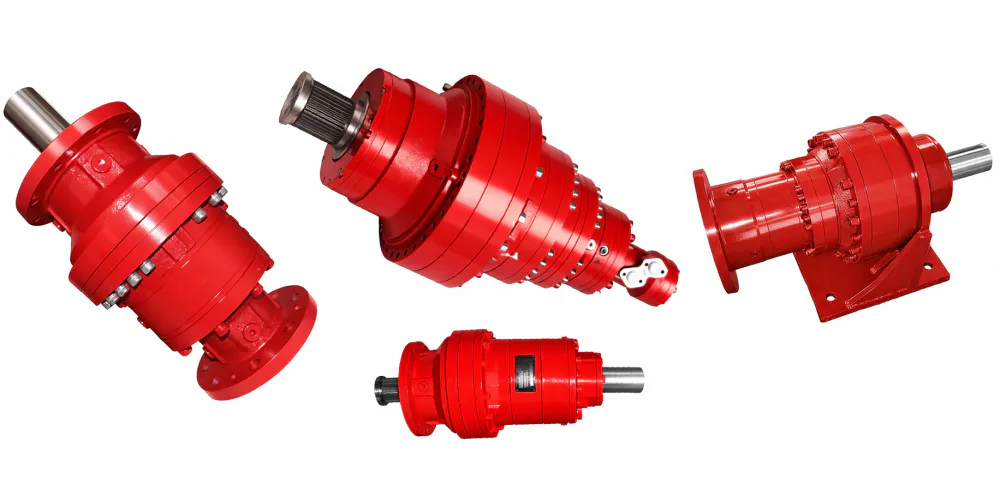
Standard Inline Two-Stage Planetary (Axes 1–3)
The most common configuration for the three proximal axes of six-axis robots. Two planetary reduction stages in a single housing achieve ratios in the 16:1 to 100:1 range required for the base, shoulder, and elbow joints. The standard design uses a solid output shaft with a keyed or splined flange. Backlash in precision grade is ≤3 arcmin. Torsional stiffness for the 90 to 142 mm frame range reaches 30 to 80 Nm/arcmin — sufficient for robot joint servo loop bandwidths of 40 to 80 Hz. This is the configuration most frequently specified as a replacement gearbox in Colombian robot maintenance operations.
Hollow Bore Inline Planetary (SCARA and Wrist Axes)
A hollow through-bore output shaft allows motor power cables and signal harnesses to pass through the gearbox center, which is a structural requirement in SCARA arm joints and in some six-axis robot wrist axis designs. The hollow bore configuration adds design complexity at the output shaft bearing and seal, but eliminates the external cable loops that are a source of mechanical fatigue and robot reach constraint in solid shaft designs. Bore diameters of 14 to 50 mm accommodate the cable harness diameters used in 6 to 50 kg payload robots.
Integrated Output Flange with Cross-Roller Bearing
In SCARA robot arm joints and robot positioner axis drives, the gearbox output flange incorporates a preloaded cross-roller bearing as an integral assembly. The cross-roller bearing carries both radial and axial loads plus the moment load from the cantilevered arm and payload simultaneously, eliminating the need for a separate output bearing on the robot joint structure. This integrated configuration is dimensionally shorter than a separate bearing arrangement, which matters in the flat, profile-constrained joint housings of SCARA robots and flat rotary robot positioners used in welding and assembly automation.
4. Technical Working Principle: From Servo Motor Output to Joint Torque
Power enters the inline planetary gearbox through the input coupling, which is typically a backlash-free disk coupling connecting the servo motor shaft to the gearbox sun gear shaft. Using a backlash-free input coupling is not optional — any play in the motor-to-gearbox coupling appears directly in the TCP positioning error of the robot. The sun gear shaft is supported by a pair of preloaded angular contact ball bearings that eliminate axial and radial float of the sun gear relative to the planet gears, which would otherwise allow the sun-planet tooth contact to shift off the design load line under dynamic loading.
At the first stage, the sun gear — typically a spur gear with module 1.0 to 2.0 for the compact frame sizes used in robot joints — meshes with three or four planet gears. The load sharing across multiple simultaneous mesh contacts is the fundamental reason planetary geometry achieves the high torsional stiffness that robot joints require: each mesh contact contributes a stiffness component in parallel, and three or four parallel stiffness contributions sum to a total gear mesh stiffness three or four times higher than a single mesh could provide at the same gear tooth module. This is also why the planet tooth count is set-matched during assembly — if one planet gear has a slightly different effective tooth thickness from the others, it carries a disproportionate share of the load, reducing the effective stiffness multiplier and increasing the tooth contact stress on that planet.
The output stage of most robot joint inline planetary gearboxes uses an output flange rather than a simple shaft. The flange connects directly to the robot joint structure — the next arm link — and must transfer both the rotary torque and the bending moment loads from the arm inertia and payload through the gearbox output bearing into the gearbox housing. In a correctly designed robot joint gearbox, the output flange runout (axial and radial) is measured and certified to below 0.01 mm — a figure that must be maintained through the service life of the unit to avoid TCP drift as the robot ages. This output flange runout specification is one of the most direct quality indicators for a robot joint gearbox and one of the most frequently cited parameters in robot manufacturer acceptance testing documentation.
In the context of the broader planetary gearbox family, it is worth noting that some collaborative robot (cobot) wrist designs use a right angle planetary gearbox for the end-of-arm tool rotation axis — the same bevel planetary architecture discussed in other sections of this website. The right angle planetary gearbox allows the motor in the cobot forearm to drive the wrist rotation at 90 degrees to the forearm axis, reducing the cross-sectional diameter of the wrist module. Understanding both the inline and right angle planetary gearbox architectures is therefore relevant for robot maintenance engineers and system integrators who work across multiple robot types in a Colombian factory automation environment.
5. Technical Performance Parameters — Inline Planetary Gearbox (Industrial Robot Joint Series)
The following table presents 22 representative technical parameters for an inline planetary gearbox configured for industrial robot joint servo reducer service. Values correspond to precision-grade two-stage units in the 60 to 142 mm flange size range. Custom configurations for specific robot joint interfaces — non-standard output flange patterns, hollow bore diameters, integrated cross-roller bearing assemblies — are available on request. If your robot’s joint gearbox model is not in our standard catalogue, we can develop a custom replacement specification from dimensional drawings or a physical survey of the existing unit.
| Parameter | Specification / Value |
|---|---|
| Frame Size (Output Flange OD) | 60 / 80 / 90 / 115 / 142 / 180 mm |
| Available Ratios (i) | 4:1 – 100:1 (single and two-stage) |
| Rated Output Torque | 16 – 750 Nm (frame size dependent) |
| Peak Torque (emergency stop) | 2.5 × rated torque (5-second duration) |
| Rated Input Speed | 3,000 RPM continuous; 4,500 RPM peak |
| Backlash (standard precision) | ≤ 8 arcmin |
| Backlash (high precision — robot joint grade) | ≤ 3 arcmin |
| Ultra-high precision (cobot / assembly robot) | ≤ 1 arcmin |
| Torsional Stiffness (Nm/arcmin) | 30 – 120 Nm/arcmin (frame 80–142 mm) |
| Torsional Compliance (arcmin/Nm inverse) | 0.008 – 0.033 arcmin/Nm |
| Moment Load Capacity (output flange) | 35 – 450 Nm (frame dependent) |
| Output Flange Axial Runout | ≤ 0.008 mm (robot-grade certified measurement) |
| Output Flange Radial Runout | ≤ 0.010 mm |
| Transmission Efficiency (two-stage) | ≥ 95% at rated load and speed |
| Noise Level | ≤ 60 dB(A) at 3,000 RPM input, no load |
| Housing Material | Aluminium alloy A356-T6 (≤115 mm); Ductile iron GGG-40 (≥142 mm) |
| Gear Material | 20CrMnTi / 18CrNiMo7-6 alloy steel, carburized and precision ground |
| Gear Accuracy Grade | ISO 1328 Grade 4 – 5 (robot joint grade) |
| Lubrication Type | Synthetic grease (robot-grade, sealed for life) |
| Operating Temperature Range | −10°C to +90°C continuous; −20°C start (suitable for unheated Colombian factory environments) |
| Protection Class (IP) | IP54 standard; IP65 option for food processing / wash-down robot installations |
| Service Life (L10h) | ≥ 30,000 hours at rated load and speed (robot service life class) |
Note: Backlash is measured under a specific test torque (typically 2% of rated torque) at room temperature after the unit has completed 10 thermal cycles to stabilize the preloaded contact geometry. Published backlash values that do not specify the measurement protocol should be treated with caution in robot joint gearbox specification.
6. Manufacturing Structure & Precision Requirements
Robot joint gearbox manufacturing occupies the highest precision tier within the planetary gearbox product family. The production process diverges from standard industrial planetary gearbox manufacture at almost every step, and understanding these differences helps explain both the cost premium and the performance gap between a precision robot joint gearbox and a standard servo drive gearbox of nominally similar torque rating.
Gear blanks are forged from 20CrMnTi or 18CrNiMo7-6 alloy steel — the choice between the two alloys depends on the required case depth and core toughness. 18CrNiMo7-6 (EN 1.6587) is preferred for larger module, higher torque gears because its higher nickel content provides superior core toughness against the shock loading of emergency stops and payload impacts. After forging and rough machining, the blanks are carburized in a sealed atmosphere furnace to achieve a case depth of 0.3 to 0.6 mm at the surface hardness of HRC 58 to 62. Distortion control during carburizing is critical: the quench profile is individually optimized for each gear geometry in the product line to minimize the crown error and helix angle deviation introduced by the quench process, because these distortions consume a portion of the grinding stock allowance and require more aggressive grinding to correct — which in turn generates more grinding heat and risks introducing tensile residual stress at the tooth surface, the opposite of the compressive residual stress that carburizing is intended to create.
Gear grinding for robot joint specifications is performed on a dedicated CNC gear grinding machine with precision dresser compensation, achieving ISO 1328 Grade 4 to 5 accuracy. In practical terms, Grade 4 means the tooth-to-tooth pitch error is below 4 to 5 micrometers and the total profile deviation across the full tooth face width is below 6 to 8 micrometers. These figures are verified by a coordinate measuring machine (CMM) equipped with a gear measurement module — not by inspection with manual gauging. Each gear is measured individually, and measurement data is retained in the quality record for the gearbox serial number, enabling traceability if a field failure is investigated.
Planet carrier assembly is performed in a temperature-controlled metrology room to avoid thermal dimensional variation during selective fitting. Planet pin bore positions are verified after final machining to a positional tolerance of ±0.003 mm on a CMM before pins are pressed. Planet gears are matched in sets by effective tooth thickness measurement — gears within ±0.001 mm of the target effective tooth thickness are assembled together to ensure equal load distribution. The assembled unit’s backlash, torsional stiffness, and output flange runout are measured and recorded at room temperature after a 30-minute warm-up running cycle at no load. Units that fall outside the specified backlash band are disassembled and the planet gear set is re-selected — a procedure that occurs on approximately 8 to 12% of assemblies at first attempt, indicating how tight the tolerance stack is for sub-3-arcmin backlash specification.
7. Material System: Standard Servo Gearbox vs. Precision Robot Joint Grade
| Component | Standard Servo Drive Gearbox | Precision Robot Joint Grade |
|---|---|---|
| Housing | Aluminium alloy die cast, standard bore tolerance | A356-T6 aluminium alloy (≤115 mm), heat-treated; all bores CNC-machined to IT5 tolerance after T6 aging |
| Sun Gear | 20CrMnTi, carburized, ground to ISO Grade 6 | 18CrNiMo7-6, carburized HRC 60–62, ground to ISO Grade 4 with tooth root relief |
| Planet Gears | 20CrMnTi, carburized, ground; nominal fit | 18CrNiMo7-6, carburized, individually measured; set-matched to ±0.001 mm effective tooth thickness tolerance |
| Ring Gear | 42CrMo, through hardened, internal teeth ground to Grade 6 | 42CrMo or 20CrMnTi, case carburized, internal teeth profile-ground to Grade 4; roundness of bore to within 0.003 mm |
| Planet Carrier | Aluminium alloy, jig-bored to ±0.005 mm pin position | Ductile iron or alloy steel (for stiffness); pin positions CMM-verified to ±0.003 mm; equal spacing to ±0.5 arcsec |
| Planet Pin Bearings | Full needle roller, standard clearance | Full complement needle roller or precision cylindrical roller; zero radial clearance (interference preload); P5 tolerance class |
| Output Bearing | Preloaded angular contact ball, standard fit | Cross-roller bearing or duplex tapered roller, P4 tolerance class; preload set by selective shim, flange runout verified to ≤0.008 mm |
| Lubrication | Industrial synthetic grease, general NLGI grade 2 | Robot-grade low-drag synthetic grease: viscosity index ≥180, NLGI 1–2, tested for backlash change under temperature cycling |
| Input Coupling | Keyed rigid coupling or standard bellows | Zero-backlash disk coupling or clamping-type rigid coupling; coupling contribution to system backlash ≤0.3 arcmin |
8. Surface Treatment for Robot Joint Environments
Robot joint gearboxes operate inside a robot arm housing — a protected internal environment that is not exposed to outdoor weather but is subject to the specific conditions of each installation. In a typical automotive welding or assembly robot, the joint gearbox is enclosed within the aluminum die-cast robot arm link and exposed to the atmosphere present inside the robot housing. This internal environment is typically warm (40 to 60°C at sustained operation), may contain weld spatter aerosol particles that enter through cable entry points, and in food processing installations is subject to cleaning fluid spray if the robot arm sealing has any deficiency.
For aluminium alloy housings in the standard 60 to 115 mm frame sizes, the external surface treatment is anodizing — Type II sulfuric acid anodizing to 8 to 15 microns is sufficient for the internal robot environment, unlike the Type III hard anodize required for outdoor greenhouse applications. The anodize serves primarily to prevent galvanic corrosion at the robot arm mounting flange (aluminium-to-aluminium contact) and to provide a cleanable surface that does not absorb lubricant residue. For food processing robot installations where wash-down cleaning chemicals are used, the external anodize is supplemented by an additional PTFE impregnation of the anodic pores, and all external fasteners are specified in stainless steel A4 grade.
Internal gear surfaces receive a phosphate manganese conversion coating after grinding and before assembly. This treatment promotes lubricant film retention during the break-in phase — the first 20 to 50 operating hours during which the preloaded planet tooth contacts self-conform to their optimal contact pattern. The phosphate layer is consumed during break-in and replaced by the lubricant film; its role is entirely in facilitating a successful break-in period without adhesive wear, which would increase backlash during the first hours of robot operation and potentially cause the robot’s positional calibration to drift before the operator has established a baseline.
For robots in pharmaceutical manufacturing, electronics assembly cleanrooms, and food contact applications in Colombia — the sectors with the strictest cleanliness requirements — gearbox housing external surfaces can be electro-polished stainless steel on request, eliminating any surface porosity that could harbor contamination. This is a low-volume, higher-cost option, but it is the technically correct specification for collaborative robot (cobot) installations in direct food-contact zones or Grade C pharmaceutical cleanroom environments.
9. Environmental Rating & Operating Condition Characteristics in Robot Joint Service
IP54 is the standard ingress protection rating for robot joint gearboxes used in general factory automation environments. The dust-protected (first digit 5) and splash-resistant (second digit 4) ratings are adequate for most automotive, packaging, and electronics assembly robot installations, where the gearbox is enclosed within the robot arm structure and not directly exposed to cooling fluids, wash-down spray, or machining chip streams. For the Colombian factory automation sector — where the majority of installed robots are in automotive component, plastics, and food and beverage manufacturing facilities — IP54 covers approximately 80% of applications without upgrade.
The remaining 20% represents applications where IP65 or IP67 is required. Food and beverage robot installations, particularly meat and poultry processing facilities in the Bogotá, Medellín, and Barranquilla areas, routinely use daily high-pressure wash-down cleaning cycles that expose the robot to water jet impact at pressures above 30 bar. For these installations, IP67 (temporary immersion resistance) is the appropriate gearbox specification, combined with FKM output shaft seals and stainless steel external fasteners as discussed in the surface treatment section. The IP rating of the robot joint gearbox in these environments is a critical safety specification — contamination of the gearbox lubricant with cleaning chemicals can cause catastrophic corrosion of the planet pin bearings within weeks of a seal failure event.
The thermal duty cycle in robot joint service is characterized by high-frequency cyclic loading with short rest periods — the profile of a typical robotic welding cycle in an automotive plant is 6 to 12 robot motion commands per 60-second production cycle, with each motion command involving acceleration, constant speed traversal, and deceleration. The gearbox sump temperature stabilizes at 50 to 80°C above the internal robot arm ambient temperature at sustained production rates. The synthetic robot-grade grease specified in precision joint gearboxes maintains adequate viscosity at these temperatures without significant stiffening or degradation for the 30,000-hour design life — provided the gearbox remains sealed and the grease is not contaminated by moisture ingress from a seal failure.
10. Five Key Advantages for Industrial Robot Joint Servo Reducer Service
1. Sub-3-Arcmin Backlash for ±0.05 mm TCP Repeatability
The TCP repeatability specification of a six-axis robot is only achievable when every joint gearbox in the kinematic chain maintains backlash within its design specification. For a typical 1,400 mm reach six-axis robot, a 3 arcmin backlash error at the axis 1 base joint produces approximately 1.2 mm of TCP uncertainty at maximum reach — far exceeding the ±0.05 mm specification. Sub-3-arcmin backlash gearboxes at every joint, combined with the kinematic attenuation of the robot’s geometry at mid-reach working positions, are the mechanical foundation for meeting the TCP specification stated in robot manufacturer datasheets.
2. High Torsional Stiffness for Servo Loop Stability
A torsional stiffness of 30 Nm/arcmin and above at the gearbox output allows the robot servo controller to operate at the position loop gains required for fast, precise motion without encountering the structural resonance that causes oscillation and path error. Low-stiffness gearboxes constrain the servo gain and therefore limit the robot’s achievable path following accuracy at high speeds — a performance limitation that is invisible in static positioning tests but becomes clear in high-speed arc welding or dispensing path following applications. This is one of the key specification parameters for precision planetary gearbox Colombia automation integrators to verify at procurement.
3. Coaxial Architecture for Direct Servo Motor Integration
The inline (coaxial) configuration allows direct axial coupling between the servo motor shaft and the gearbox input without direction change components. This keeps the joint mechanism compact in the motor-axis direction, which is the primary space constraint in the shoulder and elbow joints of articulated robots where the arm profile width determines the robot’s ability to reach into confined workspaces such as automotive body cavities. The absence of bevel gears in the inline configuration also eliminates the bevel mesh as a potential noise source and backlash contributor in joints 1 through 3 where the inline architecture is standard.
4. 30,000-Hour Service Life for Minimized Production Downtime
At a standard robot utilization of 6,000 production hours per year, a 30,000-hour gearbox life rating corresponds to a 5-year expected service interval between joint gearbox replacements — consistent with typical automotive robot overhaul cycles. For Colombian factory operations where robot downtime has a direct cost impact on production line throughput, specifying gearboxes at the full 30,000-hour rating — rather than accepting lower-life alternatives at lower initial cost — is economically justified when the cost of an unplanned joint failure and resulting production stop is factored into the total cost of ownership calculation.
5. Drop-In Replacement Compatibility with Major Robot Brands
Robot joint gearboxes are high-value replacement parts for the major robot brands operating in the Colombian market — ABB, FANUC, KUKA, Yaskawa/Motoman, and UR cobot platforms. Our precision inline planetary gearbox range includes direct replacement configurations for the most common joint gearbox assemblies in these platforms, verified by output flange pattern, shaft dimensions, and backlash specification. For models not in our standard replacement catalogue, our engineering team develops custom-dimensioned replacements from the original gearbox dimensional drawing or from a physical unit survey, typically within 15 to 20 working days from receipt of dimensional data.
Working on a robot installation that includes wrist axis drives with 90-degree output orientation? Our right angle planetary gearbox range covers the bevel-output configurations used in collaborative robot wrist joints and external robot positioner axes. See our complete planetary gearbox product range for both inline and right angle configurations, or explore our robot joint gearbox replacement guide for major robot brand compatibility data.
11. Operating Condition Characteristics in Industrial Robot Joint Service
Robot joint gearboxes face a duty cycle profile that is challenging in ways that static torque calculations alone cannot capture. Consider a six-axis robot performing automotive windshield adhesive dispensing: the robot executes a complex 3D path at constant TCP speed, decelerating and accelerating at each corner of the path to maintain adhesive bead continuity. Every deceleration and acceleration event in the path produces a torque reversal in the joint gearboxes — a transition from positive to negative torque or vice versa that engages the backlash dead band in the gearbox twice per reversal event. At a dispensing speed of 200 mm/s on a path with 40 corners, the axis 1 gearbox experiences approximately 80 backlash traversal events per dispensing cycle. At 600 cycles per 8-hour production shift, this is 48,000 torque reversal events per shift — events that cycle the gear tooth contact through the backlash zone and subject the planet gear tooth flank surfaces to impact loading at each reversal.
This torque reversal loading mode — absent from most industrial machinery gearbox duty cycles — is the reason that robot joint gearboxes require the set-matched planet assembly and zero-clearance planet pin bearings described in the manufacturing section. A planet gear set with nominal (rather than set-matched) tooth thickness produces unequal load sharing during the dynamic tooth contact events at reversal, concentrating load on one or two planets and accelerating their tooth flank fatigue. The first sign is typically a subtle increase in the noise level at the planet mesh frequency during robot acceleration phases, eventually progressing to measurable backlash increase and TCP drift as the worn flanks produce a larger dead band in the torque reversal cycle.
The relationship between the inline planetary gearbox specification and the robot controller performance also works in the opposite direction: the servo controller’s motion planning algorithm determines the torque profiles applied to the gearbox, and an aggressively tuned controller with high jerk limits (rate of change of acceleration) applies higher impact torque peaks to the gearbox than a conservatively programmed motion profile. Colombian robot installations in high-speed packaging and electronics assembly — where maximum throughput drives the servo tuning to the aggressive end of the envelope — accordingly impose a more demanding gearbox duty cycle than equivalent robots in welding or material handling applications, even if the peak torque values are similar. Specifying the gearbox service factor with this duty cycle characteristic in mind — rather than purely on nominal torque — is an aspect of robot joint gearbox specification that distinguishes experienced robot drive train engineers from those working from catalogue data alone.
12. Typical Failure Modes and Diagnostic Indicators
Backlash Growth from Gear Tooth Wear
The most common performance failure mode in robot joint gearboxes operated beyond their service interval or in aggressively tuned high-cycle applications. Progressive wear on the planet gear flanks and sun gear teeth increases the effective clearance in the tooth mesh, expanding the backlash dead band. The robot controller’s position loop compensates for modest backlash increases by increasing the following error threshold, which initially masks the degradation from production quality monitoring. Detection requires periodic backlash measurement at the robot joint — typically done during scheduled calibration visits — and comparison against the original commissioning measurement. A backlash increase of more than 3 arcmin above the original value is typically the practical threshold for joint gearbox replacement in precision assembly robot applications.
Planet Pin Bearing Fatigue
Full complement needle roller planet pin bearings in robot joint gearboxes are subjected to the highest contact stress per unit area of any bearing element in the gearbox — a consequence of the small diameter and high load per roller. In correctly lubricated units, fatigue life exceeds the 30,000-hour design life. In units where grease has aged beyond its viscosity specification — a condition that develops in gearboxes that have exceeded their recommended service interval or that have been operated at sustained temperatures above 90°C — the needle roller surface develops white etching crack initiation sites that lead to roller surface spalling. The first audible symptom is a periodic ticking at the planet carrier rotation frequency during robot motion, best detected during a slow-speed joint traversal with the robot controller in reduced speed mode.
Output Flange Runout Increase
As the output bearing preload relaxes over time due to thermal cycling, the output flange develops increasing axial and radial runout. At the robot, this manifests as a TCP position that varies with the joint angle — a position-dependent TCP error rather than a random error, which makes it detectable through a systematic robot calibration check across multiple joint positions. Output bearing preload loss is accelerated by the cyclic axial loading from the arm inertia during vertical motion cycles — a loading mode that the angular contact output bearing is designed for, but which consumes its preload reserve faster in applications with high vertical acceleration demand.
Grease Degradation and Thermal Breakdown
Robot-grade synthetic grease has a finite useful life that depends on operating temperature, cycle frequency, and the presence of contamination. Above 80°C sustained operation, most NLGI Grade 2 grease formulations experience accelerated oil bleed — separation of the base oil from the thickener — which reduces the effective lubrication in the highest-contact-stress zones. The first indication is typically an increase in operating temperature of the gearbox housing (measurable with a contact thermometer during a robot motion sequence) as the reduced oil film increases gear mesh friction. In units where grease degradation has progressed to a stage where the lubricant film has partially failed, metal particle contamination of the remaining grease generates an abrasive wear acceleration cycle that can destroy a previously functional gearbox within weeks.
Ring Gear-to-Housing Fit Relaxation
The ring gear in an inline robot joint gearbox is press-fitted into the housing bore with an interference that must resist the reaction torque of the planetary gear mesh across the full service life. Thermal cycling — particularly in robots with frequent cold start and hot shutdown sequences — progressively relaxes this interference through differential thermal expansion. Ring gear micro-rotation is detectable as a characteristic grinding noise at the ring gear pitch frequency during high-torque acceleration phases. It is distinguished from planet mesh noise by its dependence on output torque magnitude rather than on speed alone. This failure mode is accelerated in housings where the bore roundness was not verified after final machining, as a non-round bore creates a loose-fit zone at the bore major axis that initiates micro-rotation at lower torque than the nominal interference would suggest.
13. Regulatory Framework: Industrial Robot and Gearbox Standards by Region
Industrial robot installations are among the most heavily regulated machinery categories in factory automation, because they combine high-speed movement, substantial payloads, and proximity to human workers in a way that creates significant safety risk if the machinery design, installation, and maintenance standards are not followed. The gearbox within the robot joint is not independently regulated — it is qualified through the robot as a complete system — but the gearbox manufacturer’s documentation and quality standards affect the robot OEM’s ability to meet the applicable robot safety standards.
Colombia (ICONTEC / Resolution 0312 / NTC Standards): Colombia’s occupational safety framework under Resolution 0312 of 2019 requires employers to identify and control risks from industrial machinery, including robots. The applicable Colombian technical standards for industrial robot safety are NTC-ISO 10218-1 (safety requirements for robots) and NTC-ISO 10218-2 (safety requirements for robot integration), which are direct adoptions of the ISO 10218 standard. Collaborative robot installations are additionally governed by ISO/TS 15066, which specifies the force and pressure limits for human-robot contact — a standard that directly drives the joint gearbox torque limitation requirements in cobots operating in mixed human-robot workspaces in Colombian electronics and food processing plants. The robot system integrator in Colombia bears legal responsibility under Resolution 0312 for ensuring the installed system meets the applicable standards, including verifying that replacement components (including joint gearboxes) maintain the original robot safety certification.
European Union (CE / Machinery Directive 2006/42/EC / ISO 10218): Industrial robots placed on the EU market require CE marking under the Machinery Directive. The harmonized standard EN ISO 10218-1 specifies the design requirements for the robot manufacturer, including structural integrity requirements for joint components and their connections. For collaborative robots, EN ISO/TS 15066 supplements ISO 10218-2 with the specific requirements for power and force limiting operation. The robot’s CE technical file includes the stress calculations for all joint gearboxes at rated payload and worst-case arm configuration — documentation that gearbox replacement with a non-original component can invalidate if the replacement does not meet the original specification parameters.
United States (OSHA / ANSI/RIA R15.06): OSHA 29 CFR 1910.217 covers general machinery guarding. Industrial robot safety in the US is governed by the ANSI/RIA R15.06 standard (Safety Requirements for Integration of Industrial Robots and Robot Systems), which is developed by the Robotic Industries Association and aligns with ISO 10218. For collaborative robots, R15.06-2012 and the subsequent ANSI/RIA TR R15.806 technical report on human-robot collaboration provide the specific requirements. OSHA has cited R15.06 as the applicable standard in robot-related injury investigations, making it effectively mandatory for US robot installations and for Colombian plants that export to the US market and are subject to US customer safety audits.
Germany / Japan (Robot Manufacturer Standards): The majority of industrial robots in the Colombian market are manufactured by companies headquartered in Germany (KUKA), Japan (FANUC, Yaskawa, Kawasaki, Mitsubishi), or Sweden/Switzerland (ABB). Each of these manufacturers specifies the joint gearbox replacement standards for their robots in their maintenance documentation. Using a replacement gearbox that does not meet the original backlash, torsional stiffness, and output flange runout specification may void the robot’s warranty and, more significantly, may invalidate the robot’s safety certification for applications where the original certification was based on the specific kinematic performance of the robot with original components. Colombian system integrators and robot maintenance teams should retain and verify gearbox specification documentation at the time of replacement.
ISO International Standards: ISO 9283 (performance criteria and test methods for industrial robots) defines the TCP repeatability measurement methodology that robot manufacturers use to certify ±0.05 mm TCP accuracy — a specification that depends directly on the backlash and stiffness of the joint gearboxes. ISO 10218-1 Section 5.4 requires the robot manufacturer to demonstrate structural integrity of all joint components at rated load. ISO 9001:2015 quality management certification from the gearbox manufacturer is the minimum quality assurance credential expected by robot OEMs in their component supply qualification process.
14. Recommended Configuration for Industrial Robot Joint Servo Reducer Applications
Backlash Grade Selection by Application
For arc welding, dispensing, and precision assembly robots requiring ±0.05 mm TCP: specify ≤3 arcmin backlash grade at every joint. For material handling, palletizing, and spot welding robots where positional repeatability requirements are ±0.1 mm or greater: standard-grade ≤8 arcmin backlash is acceptable at the proximal joints (axes 1–3) and precision grade only at axes 4–6 where kinematic amplification is highest. Using precision grade throughout on all applications is conservative but adds cost — matching the backlash grade to the actual TCP requirement is the engineered approach for cost-optimized procurement.
Ratio Selection for Servo Motor Matching
Select the gearbox ratio to place the servo motor at 70 to 85% of its rated speed at the maximum joint velocity in the robot’s motion program. This range keeps the motor in its highest efficiency region while preserving speed headroom for dynamic corrections. For typical 3,000 RPM servo motors and joint speeds of 100 to 200 degrees per second at the robot axis, the required ratio is 30:1 to 80:1 depending on the joint’s kinematic reduction through the arm structure. Verify the reflected inertia ratio (motor inertia divided by load inertia reflected to the motor shaft through the gearbox ratio) is in the 1:1 to 5:1 range for stable servo loop dynamics.
Output Configuration for Robot Joint Interface
Specify hollow bore output when the joint structure requires cable routing through the gearbox center — standard in SCARA arm joints and in some six-axis wrist designs. Specify solid flange output for the proximal joints where no cable routing is required through the gearbox bore. For SCARA applications, specify the integrated cross-roller bearing output flange with moment capacity exceeding the arm mass × acceleration at maximum reach. Verify that the output flange bolt circle and pilot diameter match the robot joint structure before ordering — flange pattern errors require machining adapter plates that add compliance and runout to the joint.
Service Interval and Replacement Planning
Establish a baseline backlash measurement at commissioning for every joint. Schedule a backlash re-measurement at 15,000 hours of operation (approximately 2.5 years at typical automotive production utilization) and compare against the baseline. If backlash has increased by more than 2 arcmin at any joint in a precision assembly robot, schedule gearbox replacement at the next planned maintenance stop rather than waiting for a production failure event. Pre-commissioning a replacement gearbox on a test bench and verifying its backlash and flange runout against the specification before the robot scheduled stop reduces the planned downtime duration by eliminating the possibility of a failed incoming part extending the maintenance window.

15. Application Scenarios in Factory Automation and Industrial Robotics
Automotive Component Assembly (Colombia)
Colombia’s automotive sector — including vehicle assembly operations in Bogotá and Medellín, and component manufacturing for export — uses six-axis robots for door panel assembly, instrument panel insertion, and seat frame welding. Joint gearbox specification for these applications requires ≤3 arcmin backlash for assembly tasks and ≤8 arcmin for welding positioning, with torsional stiffness above 50 Nm/arcmin to support the continuous path accuracy needed in arc welding bead quality. This is the highest-volume segment for precision inline planetary gearbox replacement in the Colombian industrial robot maintenance market.
Food and Beverage Processing (Colombia and Andean Region)
Robot-based food packaging, portioning, and primary packaging operations in Colombian food processing — including fresh produce, confectionery, and dairy product operations in the Bogotá, Cali, and Medellín areas — require IP65 or IP67 joint gearbox protection for wash-down cleaning cycles. SCARA robots are the dominant platform for flat packaging operations; six-axis units are used for case packing and portioning. The hygienic specification drives stainless steel fasteners, PTFE-impregnated anodize housings, and FKM seals throughout the joint gearbox design.
Electronics and PCB Assembly (SMT Lines)
Surface mount technology (SMT) pick-and-place operations use SCARA robots and delta robots with inline planetary gearboxes in the arm joints operating at very high cycle rates — 60 to 120 component placements per minute in high-speed lines. The cycle frequency in electronics assembly exceeds all other robot application categories and drives the highest annual torque reversal count on the joint gearboxes. The gearbox service interval for SMT line robots is typically 18,000 to 20,000 hours rather than the 30,000-hour standard automotive interval, reflecting the higher fatigue cycle accumulation rate at SMT line throughput speeds.
Collaborative Robot (Cobot) Applications
Collaborative robots — operating without safety fencing in direct proximity to human workers — use inline planetary gearboxes in their shoulder and elbow joints and in some designs use a right angle planetary gearbox in the wrist rotation axis. Cobot joint gearboxes have an additional design requirement not present in standard industrial robot gearboxes: the ability to perform torque-transparent operation where the servo controller reads the external torque through the gearbox compliance and uses this measurement for collision detection. Lower-torsional-stiffness cobot gearboxes are actually preferred for this torque transparency function, creating a design trade-off between positional stiffness and collision sensitivity that is specific to the collaborative robot architecture.
Robot Positioner and External Axis Drives
Robotic welding cells use servo-driven rotary positioners to present the workpiece to the robot at the optimal welding access angle. These positioner axes use inline planetary gearboxes for the table rotation and trunnion tilt axes — applications that combine high torque with moderate precision requirements (±0.1 mm positional accuracy is generally sufficient for weld joint access, unlike the ±0.05 mm TCP specification of the robot itself). A right angle planetary gearbox is appropriate for positioner axes where the motor must be mounted perpendicular to the rotation axis for structural reasons — an increasingly common configuration in the compact positioner designs used in Colombian automotive component welding cells.
WorkShop

16. Related Products & System Compatibility
A robot joint drive system involves more than the planetary gearbox alone. The servo motor, the zero-backlash input coupling, the motor brake (if integrated into the joint), and the gearbox are all components in a precision system where each element’s performance contributes to the final TCP accuracy of the robot. Sourcing these components with verified dimensional and performance compatibility reduces the risk of integration problems that only become visible after the robot is reassembled and calibrated — a stage where rectifying a coupling mismatch or a motor flange incompatibility requires full joint disassembly and adds hours to the maintenance stop. We offer the key components of the complete robot joint drive train alongside our precision inline planetary gearbox series, with pre-verified dimensional compatibility between components in the same frame size.
Servo Motor (Robot Joint Grade)
Robot joint servo motors require a shaft and flange geometry compatible with the zero-backlash input coupling of the matched gearbox. Our servo motor range for robot joint applications is characterized by shaft runout data (≤0.005 mm at the coupling interface) and inertia values that enable accurate reflected inertia ratio calculation for servo loop tuning. Motors are available with integrated holding brakes for joint axes where gravity loading requires brake engagement during power-off states — a safety requirement in the shoulder and elbow joints of vertical articulated robots under ISO 10218-1.

Precision Planetary Reducer (Additional Reduction Stage)
For robot joint applications requiring overall ratios above 100:1 — such as the base rotation axis of very large payload robots or heavy-duty positioner axes — an additional inline precision planetary reducer stage mounted between the motor and the primary joint gearbox provides the incremental ratio without adding an external bevel stage that would compromise the coaxial architecture. Our precision reducer series uses the same gear accuracy grade, bearing specification, and housing material standard as the primary joint gearbox, ensuring that the additional stage does not introduce an accuracy or stiffness deficit into the combined joint drive system.

Frequently Asked Questions
Q1. How does an inline planetary gearbox work inside an industrial robot joint, and why is it used instead of other gearbox types?
The inline planetary gearbox reduces the servo motor speed through one or two stages of planetary gear reduction — sun gear driving planet gears against a fixed ring gear, with the planet carrier rotating at reduced speed — while the input and output share the same rotational axis (hence “inline” or “coaxial”). This architecture is used in robot joints rather than parallel-axis helical gearboxes, worm gearboxes, or harmonic drives because it combines the highest torque density per unit volume with torsional stiffness values (30 to 120 Nm/arcmin) that enable the servo position loop bandwidths needed for fast, precise robot motion. Harmonic drives achieve lower backlash but have lower stiffness and shorter shock load life; worm gearboxes are compact but have high friction losses and limited dynamic response; parallel-axis gearboxes cannot achieve the ratio-to-volume density that planetary geometry provides in the constrained arm joint housing profile.
Q2. When is it more cost-effective to replace an industrial robot joint gearbox versus rebuilding the original unit in a Colombian production environment?
The rebuild-versus-replace decision depends on the condition of the housing, the availability of certified replacement gear sets, and the planned downtime duration. Rebuild is cost-effective when: the housing bore dimensions and roundness are within specification, the carrier pin bore positions are verified in tolerance, and certified replacement gear sets with individual measurement certificates are available within the planned downtime window. Replace is more appropriate when: the housing bore has fretting damage or has grown beyond tolerance, the carrier pin bore positions have shifted, or the downtime window is short (less than 8 hours) and the risk of a failed rebuild extending the stop is unacceptable. In most Colombian factory contexts, the cost of 24 additional hours of production downtime from a failed rebuild attempt exceeds the cost premium of a new replacement gearbox — making planned replacement the economically rational default unless the rebuild can be pre-qualified on a bench unit before the production robot is taken down.
Q3. What planetary gearbox ratio is typically used in the base rotation axis of a six-axis industrial robot?
The base rotation axis (axis 1) of a six-axis robot typically uses a gearbox ratio in the 50:1 to 80:1 range. With a 3,000 RPM servo motor and a 64:1 ratio, the output shaft speed at rated motor speed is approximately 47 RPM — translating to a base rotation speed of about 170 degrees per second, which is in the typical range for medium-payload six-axis robots. Larger payload robots (above 50 kg) use lower maximum joint speeds and correspondingly higher ratios (80:1 to 100:1) to achieve higher joint torque from the same motor frame size. The exact ratio is determined by the robot OEM based on the kinematic model, payload specification, and servo motor selection, and replacement gearboxes must use the original ratio exactly to preserve the robot’s motion program speed calibration.
Q4. Which inline planetary gearbox configuration works best for SCARA robot arm joints in Colombian electronics assembly plants?
For SCARA robot arm joints in Colombian electronics assembly, specify a hollow bore inline planetary gearbox with an integrated cross-roller output bearing, backlash ≤3 arcmin, and torsional stiffness ≥35 Nm/arcmin in the 80 mm frame size for the outer arm joint and 115 mm frame for the inner arm joint. The hollow bore — typically 25 to 35 mm for this payload class — allows the motor cable harness to pass through the gearbox center to the inner arm structure, maintaining the compact SCARA arm profile that keeps the robot within the work cell footprint. IP54 is adequate for most Colombian electronics assembly environments; if the factory operates aggressive ionic cleaning of PCBs in proximity to the robot, IP65 with stainless steel fasteners is the safer specification to prevent flux vapour condensation on the gearbox housing from entering through the input shaft seal.
Q5. What is the right angle planetary gearbox’s role in the wrist axis of a collaborative robot, and how is it specified differently from an inline joint gearbox?
In some collaborative robot wrist designs, the end-of-arm tool rotation axis uses a right angle planetary gearbox to accept motor input from the cobot forearm direction and redirect the output 90 degrees to the transverse wrist rotation axis. This reduces the outer diameter of the wrist module — critical for a cobot designed to reach into confined spaces. The right angle planetary gearbox in this application is specified for lower backlash than a standard right angle unit (≤5 arcmin rather than the ≤8 arcmin typical of greenhouse or machine tool applications) because TCP error at the wrist axis has a 1:1 relationship to positioning error, with no kinematic attenuation from downstream arm geometry. Torsional stiffness is typically lower than the inline joint gearboxes in the same cobot’s shoulder and elbow joints, because cobot wrist axes carry lower inertia loads and because the torque transparency for collision detection is more important in the wrist than in the proximal joints.
Q6. What are the signs that an industrial robot joint gearbox needs replacement in a Colombian automotive assembly plant?
The five most reliable diagnostic indicators are: TCP calibration drift that recurs within weeks of recalibration (indicating backlash growth, not a calibration artifact); a periodic tick or knock at the planet carrier frequency audible during slow-speed joint traversal in reduced speed mode; increasing following error alarm frequency in the robot controller event log, particularly during high-acceleration path segments; increased joint motor current draw at the same path speed compared to baseline (indicating increased friction from grease degradation or bearing wear); and position-dependent TCP error that increases at extended arm positions (indicating output bearing preload loss). Any two of these five indicators occurring together is sufficient justification for scheduling gearbox replacement at the next planned maintenance stop.
Editor: PXY